Demonstrative Adjectives (この・その・あの・どの)
Learning objectives
- Distinguish between demonstrative pronouns (これ) and demonstrative adjectives (この).
- Use この, その, あの, and どの to modify nouns based on distance.
- Learn how to point at and choose items in a Japanese store.
- Understand basic shopping etiquette in Japan.
In Chapter 04, we learned これ, それ, and あれ, which stand alone as nouns (“This is a book”). In this chapter, we level up to この, その, and あの. These are demonstrative adjectives, meaning they must be followed by a noun (“This book is mine”). This system follows the same distance rules as before but allows for much more specific descriptions.
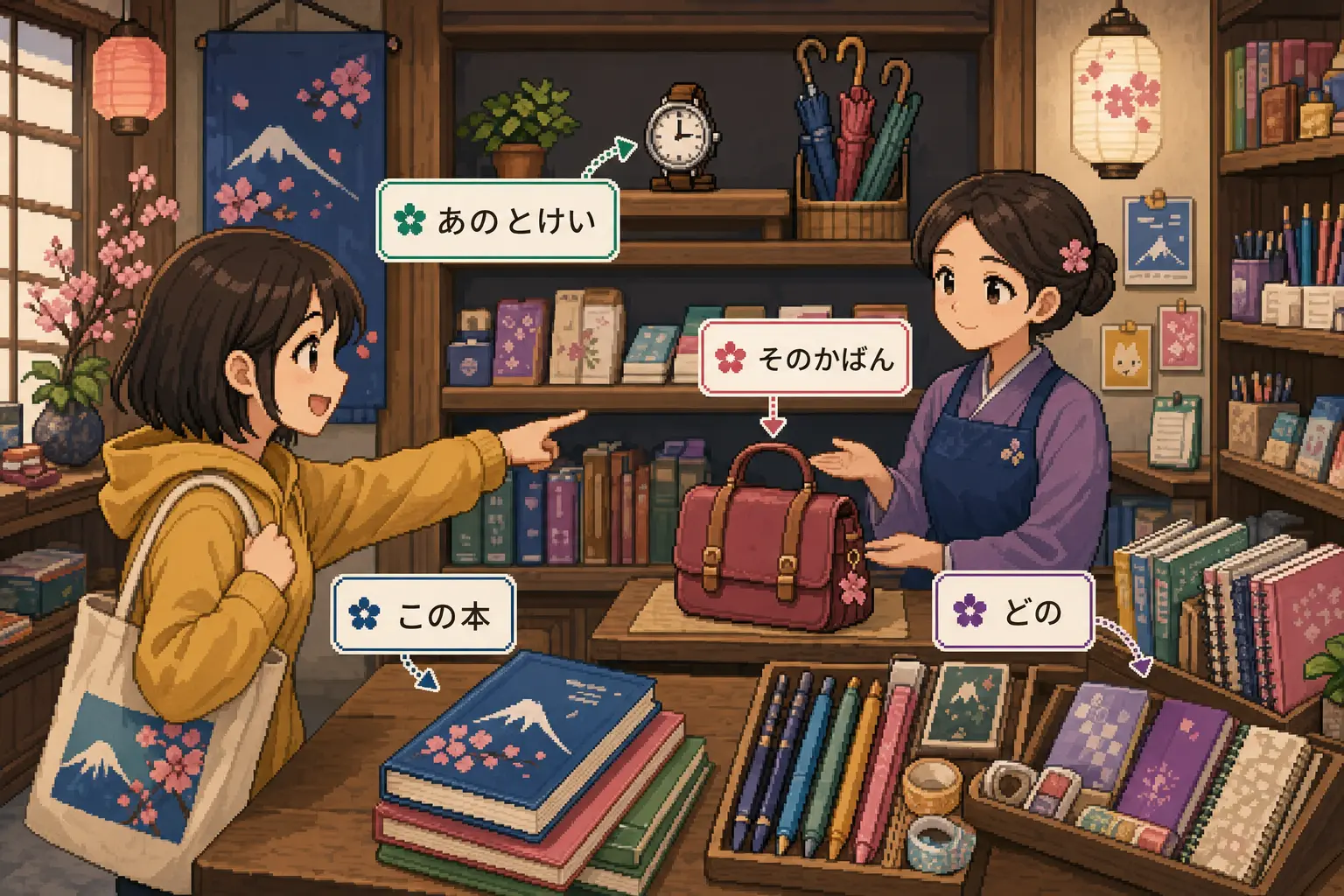
1. The Ko-So-A-Do System: Adjective Forms
The Ko-So-A-Do prefixes (Ko = Near me, So = Near you, A = Far from both, Do = Which?) still apply. The only difference is that these versions require a noun immediately after them.
means Specifies a particular noun based on distance.
Formation
Demonstrative Adjective + Noun
この ほん は わたし の です。
Kono hon wa watashi no desu.
This book is mine.
その かばん は だれ の です か。
Sono kaban wa dare no desu ka.
Whose bag is that (near you)?
あの くるま は たかい です。
Ano kuruma wa takai desu.
That car (over there) is expensive.
Differences: これ vs この
- これ (Pronoun): Stands alone. (これ は ほんです - This is a book.)
- この (Adjective): Must touch a noun. (この ほん は おもしろいです - This book is interesting.)
どの ひと が たなかさん です か。
Dono hito ga Tanaka-san desu ka.
Which person is Mr. Tanaka?
この ペン を ください。
Kono pen o kudasai.
Please give me this pen.
その とけい は いくら です か。
Sono tokei wa ikura desu ka.
How much is that watch (near you)?
2. Asking “Which one?”: どの (Dono)
When you have multiple items and want to ask “Which [noun]?”, you use どの. It behaves exactly like its siblings.
means Asking 'Which specific [noun]?'
Formation
どの + Noun + [rest of question] + か
どの かさ です か。
Dono kasa desu ka.
Which umbrella is it?
どの カメラ が いい です か。
Dono kamera ga ii desu ka.
Which camera is good?
さとうさん は どの ひと です か。
Satou-san wa dono hito desu ka.
Which person is Mr. Sato?
あの たてもの は なん です か。
Ano tatemono wa nan desu ka.
What is that building over there?
この ケーキ は おいしい です。
Kono keeki wa oishii desu.
This cake is delicious.
その じしょ は べんり です。
Sono jisho wa benri desu.
That dictionary (near you) is convenient.
3. Cultural Note: Shopping Etiquette (買い物)
Shopping in Japan is a polite, ritualized experience. Here are a few key points:
- Sumimasen: Use this to get a clerk’s attention.
- Kore o kudasai: “Please give me this.” (Used when you’ve decided).
- Trays for Money: Most stores have a small tray (tsuri-zara) on the counter. Place your cash or card there rather than handing it directly to the clerk.
- Bowing: Clerks will often bow when you enter (Irasshaimase!) and when you leave. A small nod back is sufficient.
- Pointing: While pointing is common, it’s considered more polite to use an open hand toward the item rather than a single finger for people or expensive items.
Conversation Practice
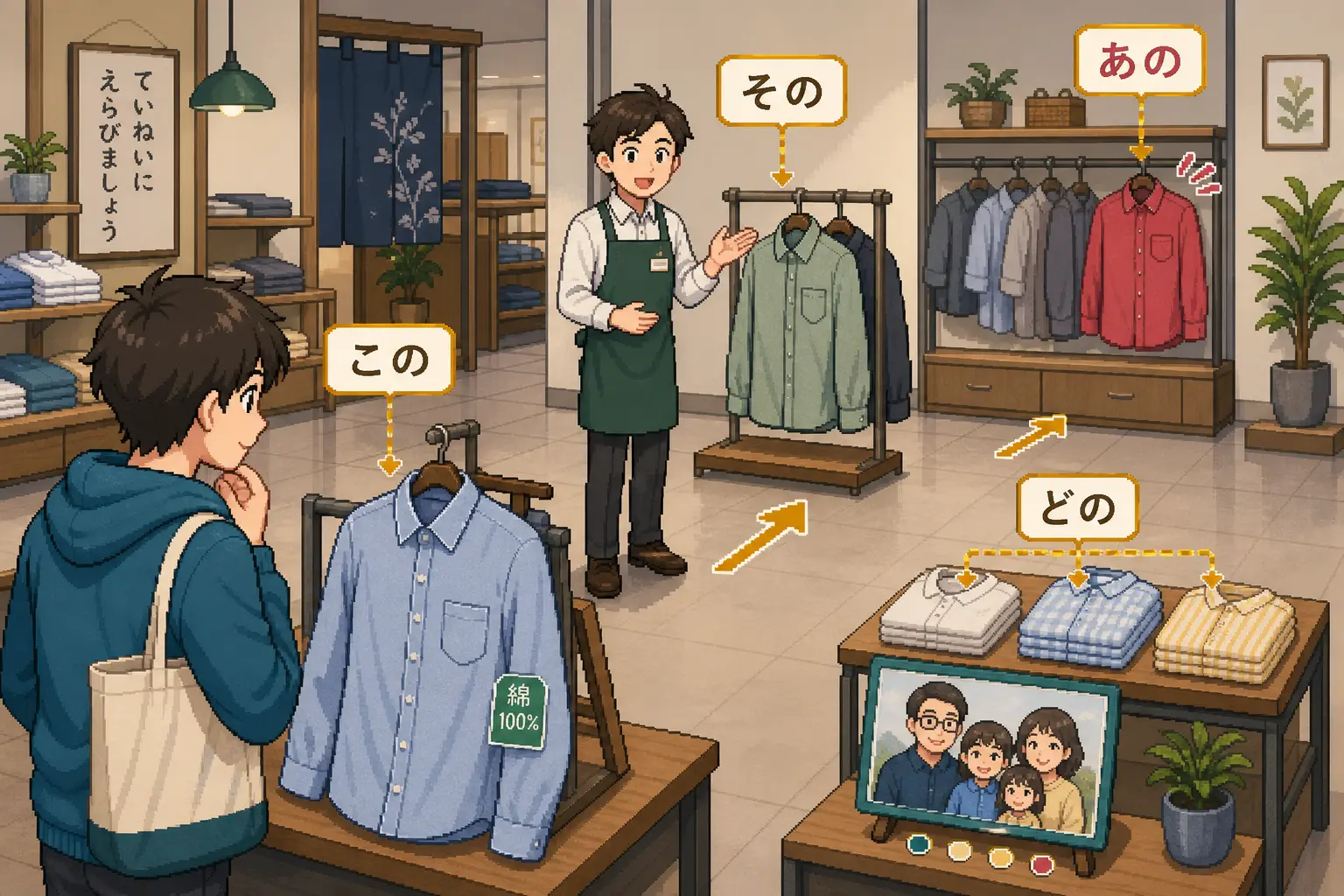
すみません。 その シャツ は いくら です か。
Sumimasen. Sono shatsu wa ikura desu ka.
Excuse me. How much is that shirt (near you)?
これ です か。 これ は 3000えん です。
Kore desu ka. Kore wa san-zen en desu.
This one? This is 3,000 yen.
じゃあ、 あの あかい シャツ は いくら です か。
Jaa, ano akai shatsu wa ikura desu ka.
Well then, how much is that red shirt over there?
あの シャツ は 4500えん です。
Ano shatsu wa yon-sen go-hyaku en desu.
That shirt is 4,500 yen.
そうですか。 この シャツ を ください。
Sou desu ka. Kono shatsu o kudasai.
I see. Please give me this shirt (the one I am holding).
これ は だれ です か。
Kore wa dare desu ka.
Who is this?
それ は わたし の かぞく です。
Sore wa watashi no kazoku desu.
That is my family.
どの ひと が おとうさん です か。
Dono hito ga otousan desu ka.
Which person is your father?
あの せ が たかい ひと です。
Ano se ga takai hito desu.
It's that tall person over there.
Chapter Summary
- 1この (kono), その (sono), あの (ano), and どの (dono) are demonstrative adjectives.
- 2Unlike これ, それ, and あれ, they MUST be followed by a noun.
- 3この = near speaker, その = near listener, あの = far from both, どの = which?.
- 4When shopping, use 'Sumimasen' to call a clerk and 'Kudasai' to buy an item.
- 5Always use the money tray at the register if one is provided.
Knowledge Check
Test your mastery of the demonstrative adjectives!
Which of these MUST be followed by a noun?
Practice Quiz
Which of these MUST be followed by a noun?
- これ (kore)
- この (kono)
- それ (sore)
- あれ (are)
Which word means 'Which [noun]'?
- どの (dono)
- どれ (dore)
- なに (nani)
- だれ (dare)
Translate: 'That car over there is expensive.'
- これ くるま は たかい です。
- その くるま は たかい です。
- あの くるま は たかい です。
- どの くるま は たかい です か。
True or False: 'この は ほんです' is a grammatically correct sentence.
- True
- False
How do you ask 'Whose bag is that (near you)?'?
- この かばん は だれ の です か。
- その かばん は だれ の です か。
- あれ は だれ の です か。
- どの かばん です か。
In a Japanese store, where should you usually place your money?
- Directly into the clerk's hand
- On the counter
- In the small tray provided
- In a gift box
Which word completes the sentence: '_____ カメラ を ください。' (Please give me this camera [in my hand]).
- これ
- この
- それ
- その
What is the polite phrase to use when you have decided to buy an item?
- Sumimasen
- Arigatou
- Kore o kudasai
- Irasshaimase
Translate: 'Dono hito ga Tanaka-san desu ka.'
- Who is Tanaka-san?
- Where is Tanaka-san?
- Which person is Tanaka-san?
- Is that Tanaka-san?
What does the clerk say when you enter a store?
- Sayounara
- Sumimasen
- Irasshaimase
- Oyasumi
Which prefix refers to the area far from both people?
- Ko-
- So-
- A-
- Do-
Fill in the blank: '_____ たてもの は なんですか。' (What is that building over there?)
- この
- その
- あの
- どの
Which is more polite when pointing at an expensive item?
- One finger
- The whole hand
- Nodding your head
- Using a pen
Translate: 'その とけい は いくら です か。'
- How much is this watch?
- How much is that watch (near you)?
- Whose watch is that?
- Which watch is it?
If you want to say 'This cake is delicious', which is correct?
- これ ケーキ は おいしい です。
- この ケーキ は おいしい です。
- ケーキ は これ です。
- おいしい ケーキ です。
Applied review
Use what you learned
Focus: Demonstrative adjectives. Try the task before revealing the model.
Produce the Japanese sentence, then compare it with the model answer.
1.Ask “Which bag is yours?”
Demonstrative adjectives in context
N5 mini-reading
- Which book belongs to the teacher?