Places & Particles へ and で
Learning objectives
- Use the particle へ (e) to indicate the destination of movement.
- Use the particle で (de) to mark the location where an action happens.
- Use the particle で (de) to express the means of transportation.
- Navigate Japan's train culture and IC card system.
Now that you can tell time and introduce yourself, it’s time to move! In Japanese, we use different particles depending on whether a place is a destination we are heading toward, or a location where we are performing an activity. We also use particles to explain how we get there. Let’s explore the world of places and movement!
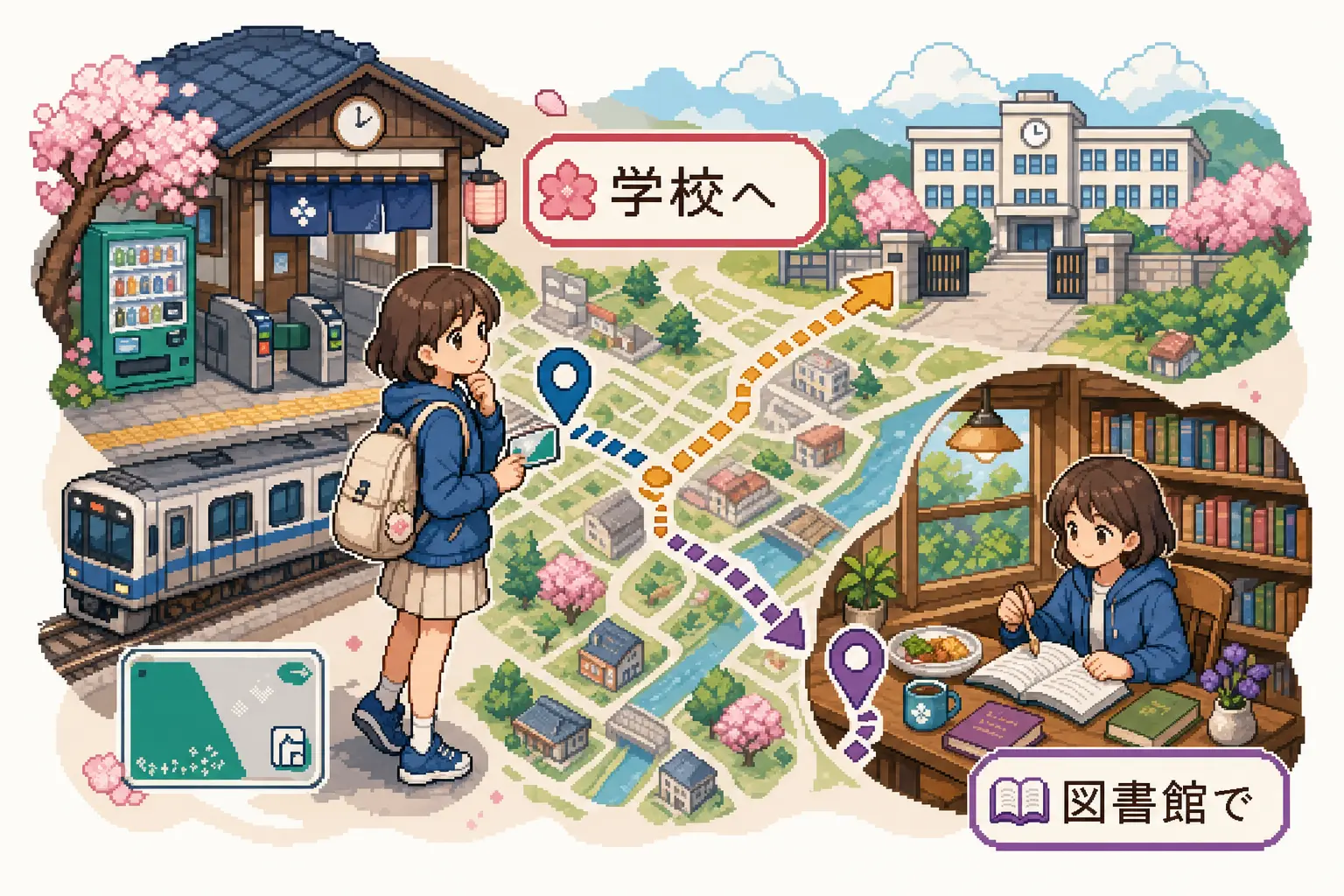
1. Destination: [Place] + へ (e)
When you are moving toward a place (going, coming, or returning), you mark that destination with へ.
[!CAUTION] The Hiragana character へ (he) is pronounced “e” when it is used as a particle.
means Going toward a destination.
Formation
Noun (Place) + へ + いきます / きます / かえります
がっこう へ いきます。
Gakkou e ikimasu.
I go to school.
にほん へ きました。
Nihon e kimashita.
I came to Japan.
うち へ かえります。
Uchi e kaerimasu.
I am going home (returning home).
どこ へ いきます か。
Doko e ikimasu ka.
Where are you going?
あした、 だいがく へ いきます。
Ashita, daigaku e ikimasu.
Tomorrow, I will go to the university.
スーパー へ いきます。
Suupaa e ikimasu.
I am going to the supermarket.
2. Location of Action: [Place] + で (de)
When you perform an action at a place (reading, eating, studying, etc.), you mark that place with で.
means Performing an action at a specific location.
Formation
Noun (Place) + で + Verb
としょかん で ほん を よみます。
Toshokan de hon o yomimasu.
I read books at the library.
レストラン で ごはん を たべます。
Resutoran de gohan o tabemasu.
I eat a meal at a restaurant.
うち で にほんご を べんきょうします。
Uchi de Nihongo o benkyoushimasu.
I study Japanese at home.
[!TIP] へ vs. で:
- Use へ for movement toward a goal (going to).
- Use で for activity happening in a spot (doing at).
どこ で べんきょうします か。
Doko de benkyoushimasu ka.
Where do you study?
デパート で かばん を かいました。
Depaato de kaban o kaimashita.
I bought a bag at the department store.
あした、 こうえん で あいましょう。
Ashita, kouen de aimashou.
Let's meet at the park tomorrow.
3. Means of Transport: [Vehicle] + で (de)
The particle で has another job! It also indicates the “means” or “tool” you use to do something. When followed by a movement verb, it tells us how you are traveling.
means Going by [means of transport].
Formation
Noun (Vehicle) + で + Movement Verb
でんしゃ で いきます。
Densha de ikimasu.
I go by train.
くるま で うち へ かえります。
Kuruma de uchi e kaerimasu.
I return home by car.
じてんしゃ で きました。
Jitensha de kimashita.
I came by bicycle.
[!NOTE] Walking: If you go on foot, you say あるいて (aruite). You do NOT use the particle で here because “walking” is a form of the verb itself, not a separate tool/vehicle.
へ vs で vs に — the three place particles so far
がっこう へ いきます。
gakkou e ikimasu — moving toward a goal (with iku/kuru/kaeru).
がっこう で べんきょうします。
gakkou de benkyou shimasu — where an activity happens.
しちじ に おきます。
shichi-ji ni okimasu — a specific time (Ch.08) or where something exists (Ch.13).
4. Cultural Note: Train Culture & IC Cards (電車)
Trains are the lifeblood of Japan. The system is incredibly efficient but can be overwhelming for beginners.
- Quiet Zones: Trains are generally quiet. Talking on the phone is strictly prohibited, and loud conversations are discouraged.
- IC Cards (Suica/Pasmo): Instead of buying paper tickets, most people use rechargeable IC cards. You just tap them on the gate when you enter and exit. Today, these can even be stored on your smartphone.
- Priority Seats: Look for the “Priority Seat” (Yuusen-seki) signs. These are reserved for the elderly, injured, pregnant, or those with disabilities. It is polite to offer your seat if someone in need is standing.
- Rush Hour: Be prepared for “Kasshu” (crush) during morning and evening commutes in big cities like Tokyo!
Conversation Practice
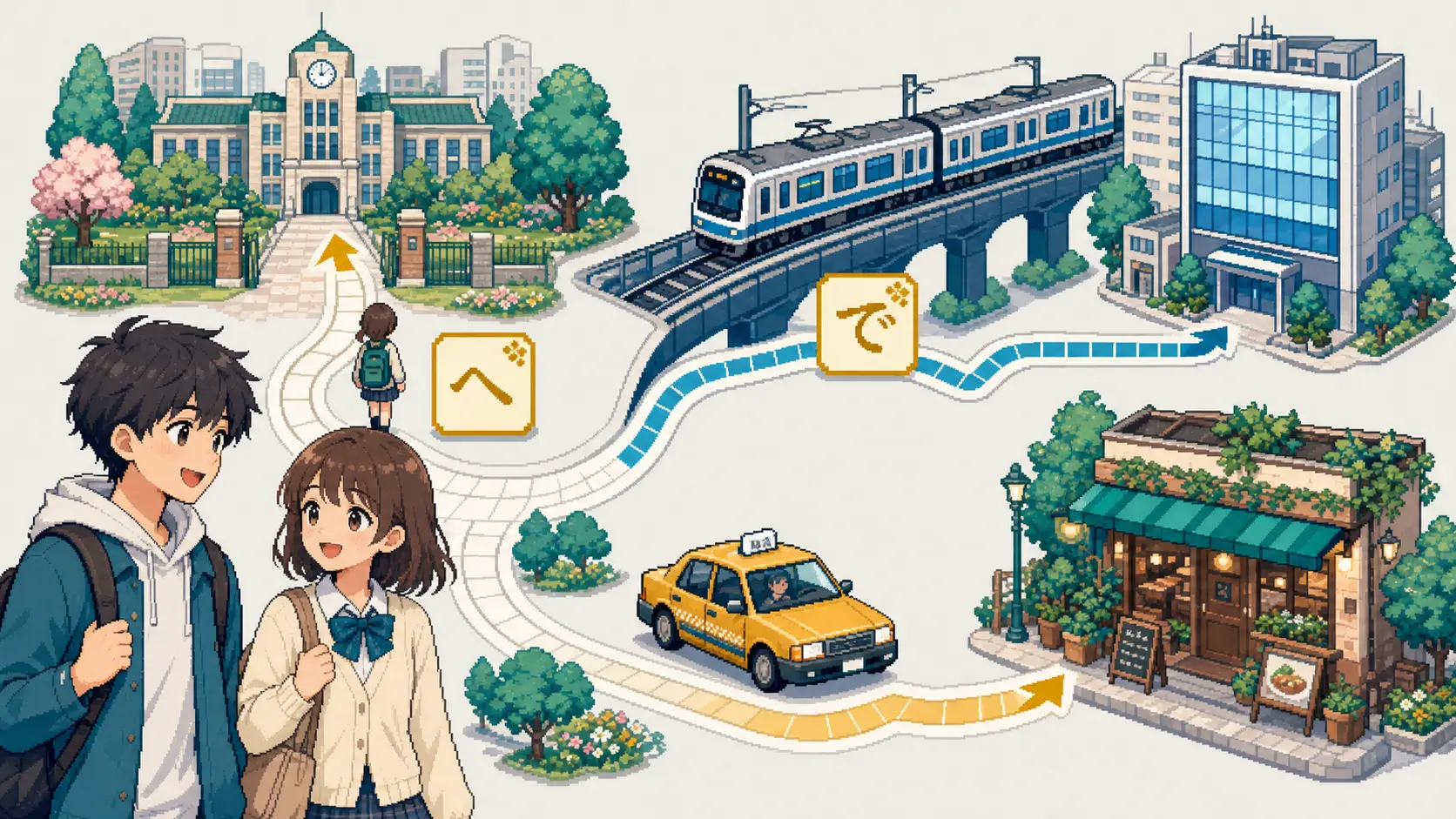
たなかさん、 毎日 どこ へ いきます か。
Tanaka-san, mainichi doko e ikimasu ka.
Mr. Tanaka, where do you go every day?
毎日 かいしゃ へ いきます。
Mainichi kaisha e ikimasu.
I go to my company every day.
なに で いきます か。
Nani de ikimasu ka.
How (by what means) do you go?
でんしゃ で いきます。 アリスさん は?
Densha de ikimasu. Arisu-san wa?
I go by train. How about you, Alice?
わたし は あるいて だいがく へ いきます。
Watashi wa aruite daigaku e ikimasu.
I walk to the university.
今日 は どこ で ごはん を たべます か。
Kyou wa doko de gohan o tabemasu ka.
Where will you eat today?
あの レストラン で たべます。 いっしょ に いきます か。
Ano resutoran de tabemasu. Issho ni ikimasu ka.
I'll eat at that restaurant over there. Want to go together?
はい、 いきましょう! なに で いきます か。
Hai, ikimashou! Nani de ikimasu ka.
Yes, let's go! How shall we get there?
タクシー で いきましょう。
Takushii de ikimashou.
Let's go by taxi.
Chapter Summary
- 1Use へ (e) for the destination of movement (going TO).
- 2Use で (de) for the location of an activity (doing AT).
- 3Use で (de) for the means of transport (by car, by train).
- 4Say 'aruite' for 'on foot' (no particle).
- 5Trains are quiet spaces; use IC cards for easy travel.
Knowledge Check
Test your understanding of places and particles!
Which particle indicates the destination of movement?
Practice Quiz
Which particle indicates the destination of movement?
- は
- へ
- で
- を
How is the destination particle へ pronounced?
- he
- ha
- e
- wa
Which particle marks the location where an action happens?
- に
- で
- へ
- の
Translate: 'I read books at the library.'
- としょかん へ ほん を よみます。
- としょかん で ほん を よみます。
- としょかん に ほん を よみます。
- としょかん の ほん を よみます。
Which particle means 'by means of' (e.g., by train)?
- に
- で
- を
- へ
How do you say 'I go on foot'?
- あるいて で いきます。
- あるいて いきます。
- あし で いきます。
- あるい で いきます。
Translate: 'Densha de kaisha e ikimasu.'
- I go to the company by train.
- I go to the train station.
- I work at the company.
- The train goes to the company.
What is an 'IC Card' used for in Japan?
- Calling friends
- Buying groceries and riding trains
- Entering hotels
- Identifying yourself
Fill in the blank: 'Resutoran _____ gohan o tabemasu.'
- へ
- で
- を
- に
What is the Japanese word for 'bicycle'?
- densha
- kuruma
- jitensha
- takushii
Which is considered rude on a Japanese train?
- Reading a book
- Sleeping
- Talking loudly on a phone
- Using an IC card
How do you ask 'How (by what means) do you go?'
- Doko de ikimasu ka.
- Itsu ikimasu ka.
- Nani de ikimasu ka.
- Dare to ikimasu ka.
Translate: 'Uchi e kaerimasu.'
- I go to the house.
- I return home.
- I am at home.
- I leave home.
Which particle would you use to say you used 'chopsticks' to eat?
- を
- は
- で
- へ
Fill in the blank: 'Doko _____ ikimasu ka.' (Where are you going?)
- で
- へ
- を
- の
Applied review
Use what you learned
Focus: Destination and action place. Try the task before revealing the model.
Produce the Japanese sentence, then compare it with the model answer.
1.Say “I go to the library and study there.”
Destination and action place in context
N5 mini-reading
- What does で mark in the first sentence?