Counters Part 1 & the て-form (Connector)
Learning objectives
- Master the native Japanese counting system (一つ, 二つ...) for general objects.
- Learn specific counters for small/compact items (〜個) and thin items (〜枚).
- Conjugate verbs into the て-form (te-form) to link multiple actions.
- Explore the Japanese culture of Omiyage (souvenir giving).
In English, we say “three books,” “three cars,” and “three people.” The word “three” never changes. In Japanese, however, you cannot just say a number. You must use a Counter—a specific suffix that depends on the shape, size, or type of the object you are counting!
Additionally, this chapter introduces the て-form (te-form), the “connector” of the Japanese language. Together, these tools allow you to describe complex scenarios like “I bought two apples and three oranges.”
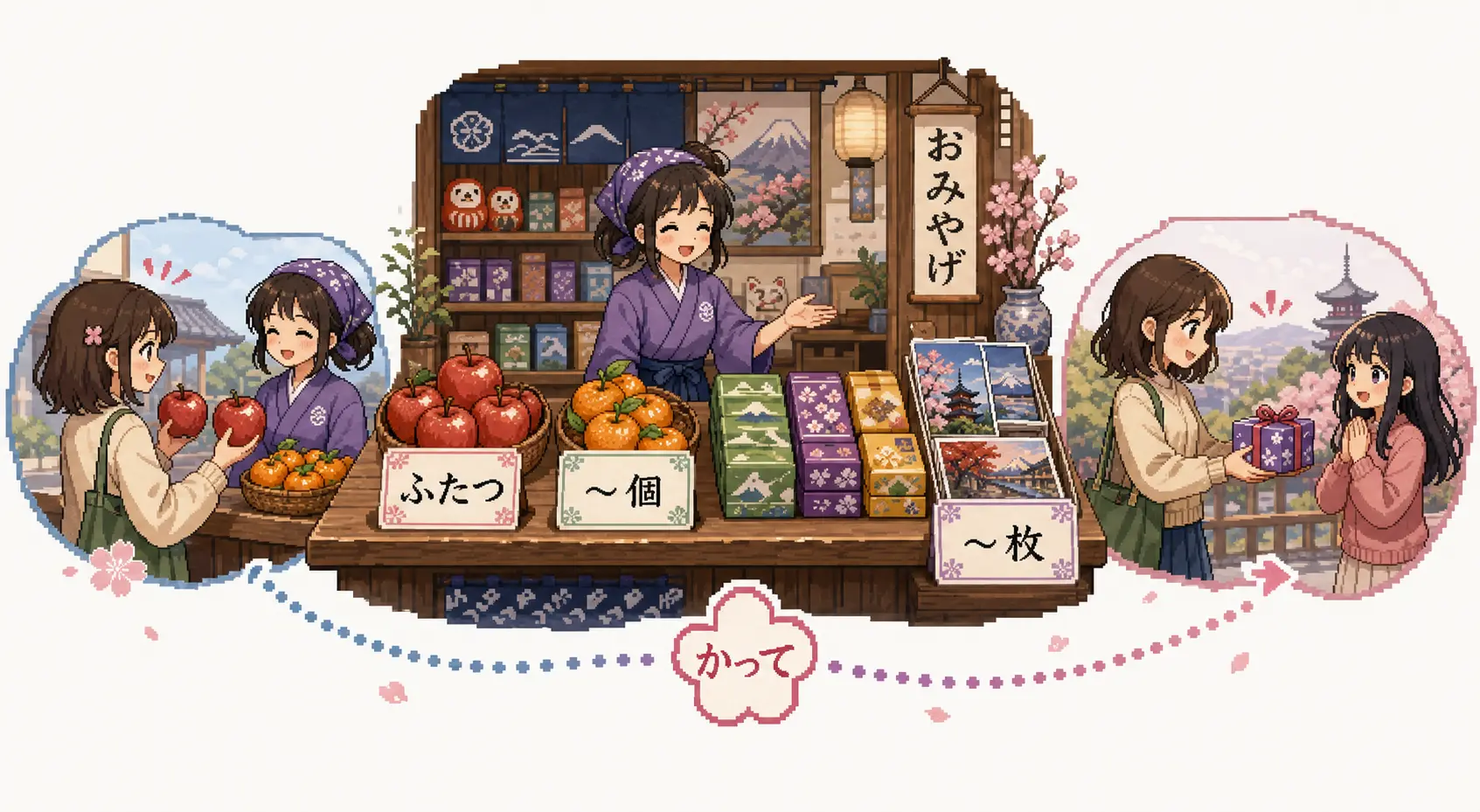
1. The Universal Counters: 〜つ (tsu)
If you don’t know the specific counter for an object, the native Japanese number system is your “safety net.” These are used for generic items, abstract concepts, or anything that doesn’t have a more specific counter.
ひとつ
Counterひとつ
hitotsu
1 (item)
ふたつ
Counterふたつ
futatsu
2 (items)
みっつ
Counterみっつ
mittsu
3 (items)
よっつ
Counterよっつ
yottsu
4 (items)
いつつ
Counterいつつ
itsutsu
5 (items)
むっつ
Counterむっつ
muttsu
6 (items)
ななつ
Counterななつ
nanatsu
7 (items)
やっつ
Counterやっつ
yattsu
8 (items)
ここのつ
Counterここのつ
kokonotsu
9 (items)
とお
Counterとお
too
10 (items)
means Counting objects in a sentence.
Formation
The counter usually comes AFTER the particle を and BEFORE the verb.
りんご を ふたつ たべました。
Ringo o futatsu tabemashita.
I ate two apples.
ハンバーガー を みっつ ください。
Hanbaagaa o mittsu kudasai.
Three hamburgers, please.
かばん が ひとつ あります。
Kaban ga hitotsu arimasu.
There is one bag.
みかん を いつつ かいました。
Mikan o itsutsu kaimashita.
I bought five mandarin oranges.
いす を よっつ ください。
Isu o yottsu kudasai.
Four chairs, please.
へや に テーブル が ふたつ あります。
Heya ni teeburu ga futatsu arimasu.
There are two tables in the room.
2. Small & Flat Items: 〜個 (ko) and 〜枚 (mai)
While 〜つ is universal, Japanese people prefer specific counters when the shape is clear.
- 〜個 (ko): For small, round, or compact objects (apples, eggs, candy).
- 〜枚 (mai): For thin, flat objects (paper, shirts, plates, tickets).
いっこ
Counterいっこ
ikko
1 (small item)
にこ
Counterにこ
niko
2 (small items)
さんこ
Counterさんこ
sanko
3 (small items)
いちまい
Counterいちまい
ichi-mai
1 (flat item)
にまい
Counterにまい
ni-mai
2 (flat items)
たまご を ろっこ かいました。
Tamago o rokko kaimashita.
I bought six eggs.
きっぷ を にまい かって ください。
Kippu o nimai katte kudasai.
Please buy two tickets.
シャツ を さんまい もっています。
Shatsu o sanmai motteimasu.
I own three shirts.
3. The て-form (The Connector)
The て-form is the most versatile conjugation in Japanese. It allows you to link verbs together without ending the sentence.
Conjugation Rules:
- Group 2 (ru): Drop る ➔ add て (taberu ➔ tabete).
- Group 1 (u): Use the “te-form song” (うつる➔って, むぶぬ➔んで, く➔いて, ぐ➔いで, す➔して).
- Group 3 (Irregular): する ➔ して, くる ➔ きて.
means Do Action 1, AND THEN Action 2.
Formation
[Verb て] + [Verb]
みせ へ いって、パン を かいました。
Mise e itte, pan o kaimashita.
I went to the store and bought bread.
て を あらって、ごはん を たべます。
Te o aratte, gohan o tabemasu.
I wash my hands and eat.
ちょっと まって ください。
Chotto matte kudasai.
Please wait a moment. (matsu ➔ matte)
あさ、おきて、コーヒー を のみました。
Asa, okite, koohii o nomimashita.
In the morning, I woke up and drank coffee.
ほん を よんで、ねます。
Hon o yonde, nemasu.
I will read a book and go to sleep.
にほんご を べんきょうして、えいが を みました。
Nihongo o benkyoushite, eiga o mimashita.
I studied Japanese and watched a movie.
4. Cultural Note: Omiyage Culture (お土産)
In Japan, Omiyage (souvenirs) are much more than just travel mementos. They are a social tool used to show gratitude to colleagues, friends, and family.
- Not just for yourself: Unlike “souvenirs” in the West, Omiyage are almost always intended to be given away.
- Regional Specialties: Each region in Japan has its own Meibutsu (famous product), usually a specific food like Yatsuhashi in Kyoto or Ringo (apples) in Aomori.
- Counting Gifts: When buying Omiyage, you’ll use counters constantly!
- Okashi o jukko kaimashita. (I bought 10 sweets.)
- Hagaki o gomai kaimashita. (I bought 5 postcards.)
The presentation is key—Omiyage are always beautifully wrapped, reflecting the Japanese aesthetic of care and respect.
Conversation Practice
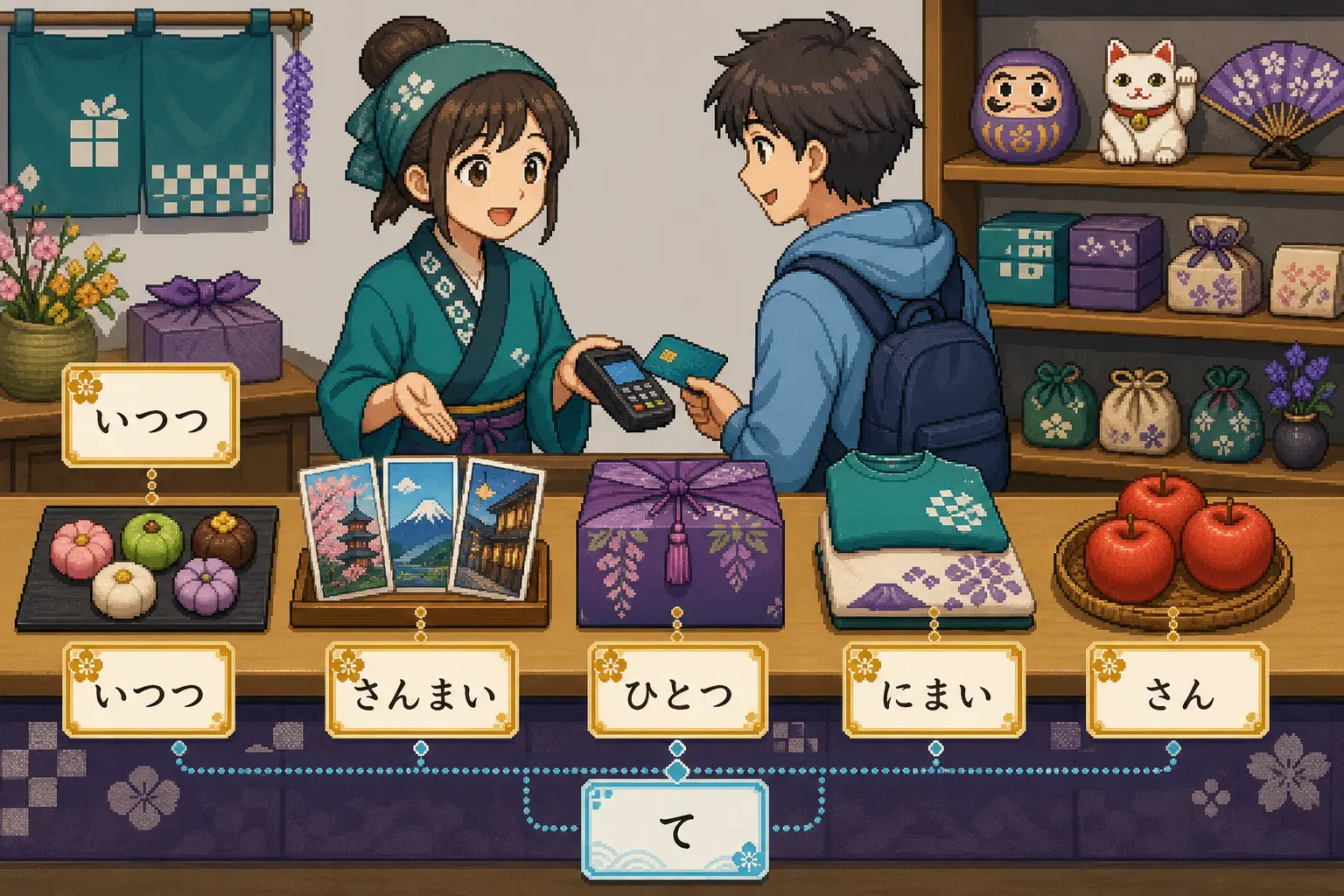
すみません、この おかし を いつ つ ください。
Sumimasen, kono okashi o itsutsu kudasai.
Excuse me, five of these sweets, please.
はい。ほか に なに か あります か。
Hai. Hoka ni nani ka arimasu ka?
Yes. Is there anything else?
ええと、ポストカード を さんまい ください。あと、きれいな はこ を ひとつ おねがいします。
Eeto, posutokaado o sanmai kudasai. Ato, kireina hako o hitotsu onegaishimasu.
Umm, three postcards, please. And one beautiful box, please.
わかりました。ぜんぶ で 2500えん です。
Wakarimashita. Zenbu de nisen gohyaku-en desu.
Understood. That's 2,500 yen in total.
カード で はらって、かえります。
Kaado de haratte, kaerimasu.
I'll pay by card and then go home.
きのう、なに を しました か。
Kinou, nani o shimashita ka?
What did you do yesterday?
デパート へ いって、シャツ を にまい かいました。それから、ともだち に あいました。
Depaato e itte, shatsu o nimai kaimashita. Sorekara, tomodachi ni aimashita.
I went to the department store and bought two shirts. After that, I met a friend.
いい です ね。わたし も かいもの を して、ごはん を たべました。
Ii desu ne. Watashi mo kaimono o shite, gohan o tabemashita.
That's nice. I also did some shopping and ate a meal.
りんご を みっつ もらいました。たべます か。
Ringo o mittsu moraimashita. Tabemasu ka?
I received three apples. Do you want to eat one?
Chapter Summary
- 1Japanese uses specific counters based on the item's shape and type.
- 2一つ (hitotsu) to 十 (too) is the universal 'safety net' counting system.
- 3Use 〜個 (ko) for small/compact items and 〜枚 (mai) for thin/flat items.
- 4The counter usually sits between the particle を and the verb.
- 5The て-form (te-form) links multiple actions together sequentially.
- 6Omiyage (souvenirs) are an essential part of Japanese social etiquette and gift-giving.
Knowledge Check
Test your counting and connecting skills!
Which counter is used for flat items like paper or shirts?
Practice Quiz
Which counter is used for flat items like paper or shirts?
- 〜つ (tsu)
- 〜個 (ko)
- 〜枚 (mai)
- 〜人 (nin)
How do you say 'three items' using the universal system?
- ひとつ
- ふたつ
- みっつ
- よっつ
Fill in the blank for 'bought two tickets'.
- ふたつ
- にまい
- にこ
- にじ
What is the te-form of 'たべる' (to eat)?
- たべった
- たべて
- たべして
- たべんで
Translate: 'Please wait a moment.'
- まって ください。
- まちて ください。
- またないで ください。
- まつの ください。
How do you say 'eight items' in the universal system?
- ななつ
- やっつ
- ここのつ
- とお
What is the te-form of the irregular verb 'する' (to do)?
- すって
- して
- すんで
- きて
Translate: 'I ate two apples.'
- りんご を にまい たべました。
- りんご を ふたつ たべました。
- りんご を ひとつ たべました。
- りんご を ににん たべました。
What is 'Omiyage'?
- A type of sushi
- A souvenir given to others
- A New Year's card
- A counting system
Which of these is the correct te-form for 'のむ' (to drink)?
- のって
- のんで
- のみて
- のんでした
Translate: 'Asa okite, koohii o nomimasu.'
- I wake up and drink coffee.
- I drink coffee before waking up.
- I want to wake up and drink coffee.
- Please wake up and drink coffee.
How many is 'とお' (too)?
- 5
- 8
- 10
- 12
Which counter would you use for 'eggs'?
- 〜枚 (mai)
- 〜個 (ko)
- 〜じ (ji)
- 〜がつ (gatsu)
What is the te-form of 'いく' (to go)?
- いいて
- いって
- いきて
- いんで
Where does the counter usually sit in a sentence?
- At the very beginning
- Between the object particle (を) and the verb
- After the verb
- Before the subject
Applied review
Use what you learned
Focus: Counters and て-form. Try the task before revealing the model.
Produce the Japanese sentence, then compare it with the model answer.
1.Ask for three apples, then connect “buy and eat”.
Counters and て-form in context
N5 mini-reading
- How many mandarins remain?