N4 Vocabulary (Expanding Your Word Bank)
Learning objectives
- Learn vocabulary for family members and relatives.
- Understand essential terms for school and the workplace.
- Master vocabulary for expressing emotions and describing people.
- Practice using these words in common N4 contexts.
As you advance to N4, grammar alone isn’t enough; you need the words to fuel those sentence structures! This chapter organizes essential N4 vocabulary thematically. By grouping words into categories like family, work, and emotions, you can memorize them more naturally through association.
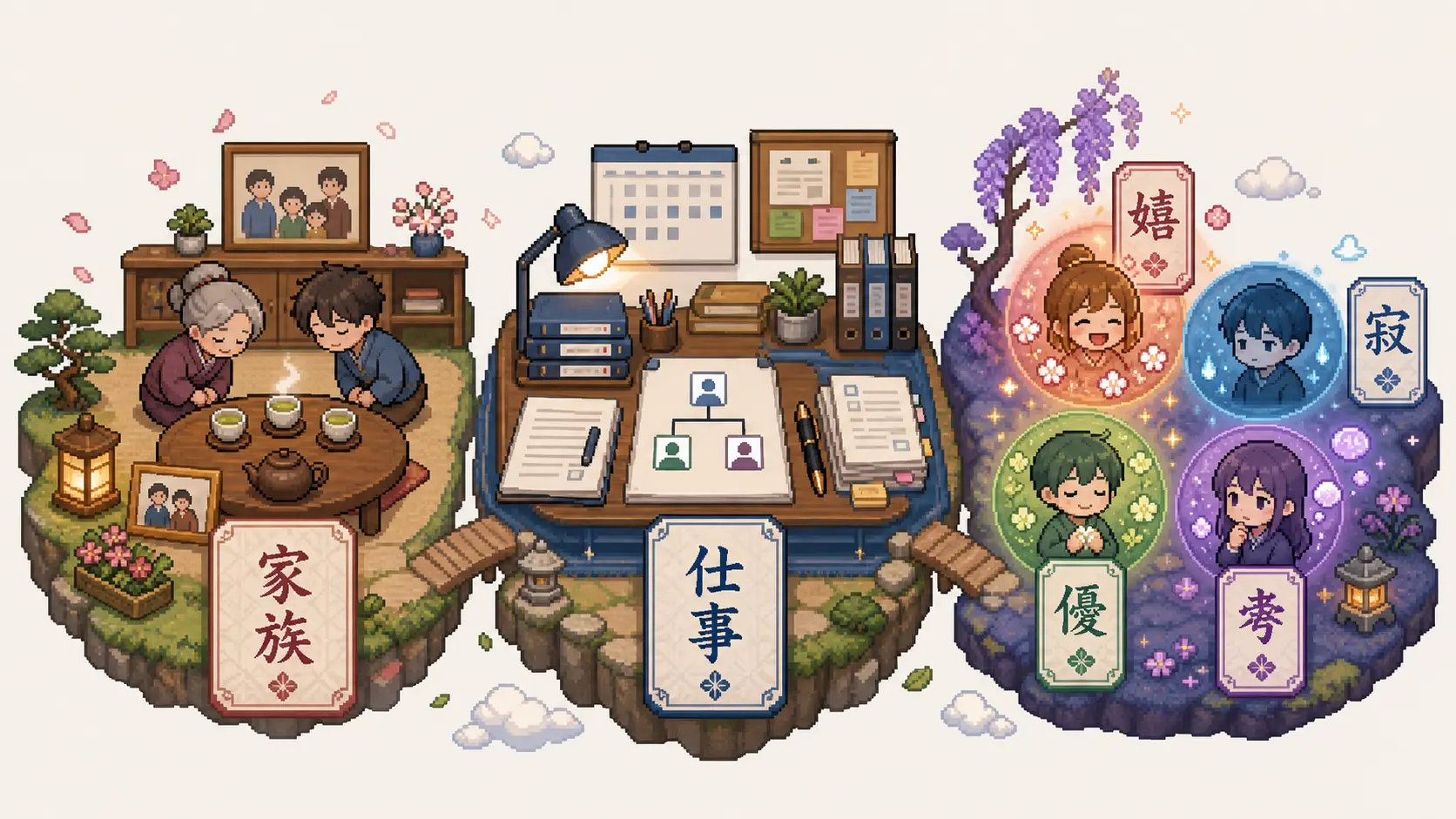
1. Family & Relatives (家族と親戚)
In Japanese, there are two sets of words for family members: humble words (used when talking about your own family) and polite words (used when talking about someone else’s family). At N4, you need to know both sets.
Grandfather
My family (humble)
祖父(そふ)
sofu
Someone else's (polite)
おじいさん
ojiisan
Grandmother
My family (humble)
祖母(そぼ)
sobo
Someone else's (polite)
おばあさん
obaasan
Father
My family (humble)
父(ちち)
chichi
Someone else's (polite)
お父さん(おとうさん)
otousan
Mother
My family (humble)
母(はは)
haha
Someone else's (polite)
お母さん(おかあさん)
okaasan
Older brother
My family (humble)
兄(あに)
ani
Someone else's (polite)
お兄さん(おにいさん)
oniisan
Older sister
My family (humble)
姉(あね)
ane
Someone else's (polite)
お姉さん(おねえさん)
oneesan
Younger brother
My family (humble)
弟(おとうと)
otouto
Someone else's (polite)
弟さん(おとうとさん)
otoutosan
Younger sister
My family (humble)
妹(いもうと)
imouto
Someone else's (polite)
妹さん(いもうとさん)
imoutosan
Wife
My family (humble)
妻 / 家内(つま / かない)
tsuma / kanai
Someone else's (polite)
奥さん(おくさん)
okusan
Husband
My family (humble)
夫 / 主人(おっと / しゅじん)
otto / shujin
Someone else's (polite)
ご主人(ごしゅじん)
goshujin
私の父はエンジニアですが、田中さんのお父さんは医者です。
watashi no chichi wa enjinia desu ga, Tanaka-san no otousan wa isha desu.
My father is an engineer, but Mr. Tanaka's father is a doctor.
週末は妻と一緒に買い物に行きます。
shuumatsu wa tsuma to issho ni kaimono ni ikimasu.
On weekends, I go shopping with my wife.
お姉さんはどこに住んでいますか。
oneesan wa doko ni sunde imasu ka.
Where does your older sister live?
Cultural Insight: Family Hierarchy & Address
In Japan, the way you address family members depends heavily on birth order. It is very common to call older siblings “Oniisan” (older brother) or “Oneesan” (older sister) instead of their names, even within the family. However, you rarely address younger siblings by a title; you just use their name followed by “-kun” or “-chan.”
When speaking to outsiders, you always use the humble terms (Chichi, Haha, etc.) for your own family, regardless of their age or status, because you are lowering your family’s status to show respect to the listener.
2. Workplace & Society (職場と社会)
When working or interacting in Japanese society, you will frequently hear these nouns and verbs.
社長
Nounしゃちょう
shachou
Company President
部長
Nounぶちょう
buchou
Department Manager
課長
Nounかちょう
kachou
Section Manager
社員
Nounしゃいん
shain
Company Employee
会議
Nounかいぎ
kaigi
Meeting
出張
Nounしゅっちょう
shucchou
Business Trip
残業
Nounざんぎょう
zangyou
Overtime Work
給料
Nounきゅうりょう
kyuuryou
Salary
明日の会議は午後三時から始まります。
ashita no kaigi wa gogo san-ji kara hajimarimasu.
Tomorrow's meeting starts from 3:00 PM.
来週、新しいプロジェクトのためにアメリカへ出張します。
raishuu, atarashii purojekuto no tame ni amerika e shucchou shimasu.
Next week, I will go on a business trip to America for the new project.
最近、残業が多くて、とても疲れています。
saikin, zangyou ga ookute, totemo tsukarete imasu.
Lately, I've had a lot of overtime work, so I am very tired.
3. Emotions & Description (感情と様子)
Expressing precisely how you feel or describing someone’s character is vital for deep communication.
嬉しい
I-adjうれしい
ureshii
Happy, glad
悲しい
I-adjかなしい
kanashii
Sad
寂しい
I-adjさびしい
sabishii
Lonely
怖い
I-adjこわい
kowai
Scary, frightened
恥ずかしい
I-adjはずかしい
hazukashii
Embarrassing, shy
優しい
I-adjやさしい
yasashii
Kind, gentle
厳しい
I-adjきびしい
kibishii
Strict, severe
真面目な
Na-adjまじめな
majime na
Serious, earnest
テストに合格して、とても嬉しいです。
tesuto ni goukaku shite, totemo ureshii desu.
I passed the test, so I am very happy.
友達が転校してしまって、今は寂しいです。
tomodachi ga tenkou shite shimatte, ima wa sabishii desu.
My friend transferred schools, so now I am lonely.
山田先生は優しいですが、時には厳しいです。
Yamada-sensei wa yasashii desu ga, toki ni wa kibishii desu.
Professor Yamada is kind, but sometimes strict.
Contextual Dialogues
Dialogue 1: Catching Up at Work (職場で)
鈴木さん、少し疲れているようですね。昨日は残業が多かったですか。
Suzuki-san, sukoshi tsukarete iru you desu ne. Kinou wa zangyou ga ookatta desu ka.
Suzuki, you look tired. Did you have a lot of overtime yesterday?
はい、課長との会議の準備をしていました。
Hai, kachou to no kaigi no junbi o shite imashita.
Yes, I was preparing for a meeting with the section manager.
それは大変でしたね。ところで、奥さんはお元気ですか。
Sore wa taihen deshita ne. Tokorode, okusan wa ogenki desu ka.
That must have been tough. By the way, how is your wife?
妻は元気です。でも、息子が病気になってしまって、少し心配です。
Tsuma wa genki desu. Demo, musuko ga byouki ni natte shimatte, sukoshi shinpai desu.
My wife is fine. But our son is sick, so I am a bit worried.
それは大変ですね。今日は早く帰って、家族といてください。
Sore wa taihen desu ne. Kyou wa hayaku kaette, kazoku to ite kudasai.
Oh no... Please go home early today to be with your family.
Dialogue 2: Talking About Family (家族の話)
佐藤さん、兄弟がいますか。
Satou-san, kyoudai ga imasu ka.
Sato, do you have any siblings?
はい、姉と弟がいます。
Hai, ane to otouto ga imasu.
Yes, I have an older sister and a younger brother.
お姉さんは何をしていますか。
Oneesan wa nani o shite imasu ka.
What does your older sister do?
姉は会社員です。とても真面目な人ですよ。
Ane wa kaishain desu. Totemo majimena hito desu yo.
My sister is a company employee. She is very serious (earnest).
そうですか。私の弟はまだ学生なので、よく試験で忙しいです。
Sou desu ka. Watashi no otouto wa mada gakusei nanode, yoku shiken de isogashii desu.
I see. My brother is still a student, so he is often busy with exams.
Chapter Summary
- 1In Japanese, you use humble words (e.g., 父, 妻) for your own family, and polite words (e.g., お父さん, 奥さん) for other people's families.
- 2Corporate hierarchy relies on specific vocabulary: 社長 (President), 部長 (Dept. Manager), 課長 (Section Manager).
- 3Actions like 会議 (meeting), 出張 (business trip), and 残業 (overtime) are essential for discussing work life.
- 4Words like 嬉しい (happy) and 寂しい (lonely) express your internal feelings vividly.
- 5The way you address family members reflects Japanese social hierarchy and respect levels.
Knowledge Check
Test your understanding of the N4 vocabulary introduced in this chapter!
Which word should you use to talk about YOUR OWN mother to a stranger?
Practice Quiz
Which word should you use to talk about YOUR OWN mother to a stranger?
- 母
- お母さん
- ママ
- 奥さん
Which word means 'Meeting'?
- 授業
- 給料
- 残業
- 会議
How do you refer to someone else's husband?
- 主人
- おっと
- ご主人
- 奥さん
What does '出張' (shucchou) mean?
- Commute
- Business trip
- Absence
- Promotion
Which adjective means 'Strict'?
- 優しい
- 寂しい
- 厳しい
- 嬉しい
What is the reading of '部長' (Department Manager)?
- しゃちょう
- かちょう
- ぶちょう
- てんちょう
Which word implies 'Overtime work'?
- 給料
- 会社員
- 残業
- 出張
Translate: 'テストに合格して、とても嬉しいです。'
- I failed the test, so I am very sad.
- I passed the test, so I am very happy.
- I am studying hard for the test.
- The test was very difficult.
What does '真面目' (majime) mean?
- Funny
- Serious / Earnest
- Lazy
- Scary
In the dialogue, why is Suzuki worried?
- He has too much overtime.
- His wife left him.
- His son is sick.
- He fired the section manager.
How do you refer to your OWN wife?
- 奥さん
- 奥様
- 妻 (つま)
- ご主人
What is the meaning of '恥ずかしい' (hazukashii)?
- Embarrassing / Shy
- Scary / Frightened
- Happy / Glad
- Loud / Noisy
What does '給料' (kyuuryou) mean?
- Taxes
- Salary
- Bonus
- Insurance
How do you read '祖父' (my grandfather)?
- そぼ
- そふ
- おじいさん
- ちち
Which of these is the lowest rank in the standard Japanese corporate hierarchy?
- 社長
- 部長
- 課長
- 社員
Applied review
Use what you learned
Focus: Family and workplace vocabulary. Try the task before revealing the model.
Produce the Japanese sentence, then compare it with the model answer.
1.Politely ask about someone else’s mother.
Family and workplace vocabulary in context
N4 mini-reading
- Which family member is a university student?