Introduction & ひらがな (Hiragana)
Learning objectives
- Understand the three Japanese writing systems: Hiragana, Katakana, and Kanji.
- Read and write the 46 base Hiragana characters.
- Master voiced marks (Dakuten and Handakuten) and combined sounds (Youon).
- Read long vowels (おう・えい) and double consonants (small っ), and follow basic stroke-order rules.
- Learn foundational vocabulary and start recognizing Japanese sounds.
Japanese may seem daunting at first with its three distinct writing systems, but it is one of the most logically structured languages in the world. Hiragana is your starting line. It represents every sound in the language and forms the grammatical skeleton of every sentence. Once you master these 46 characters, you can read and write anything in Japanese!
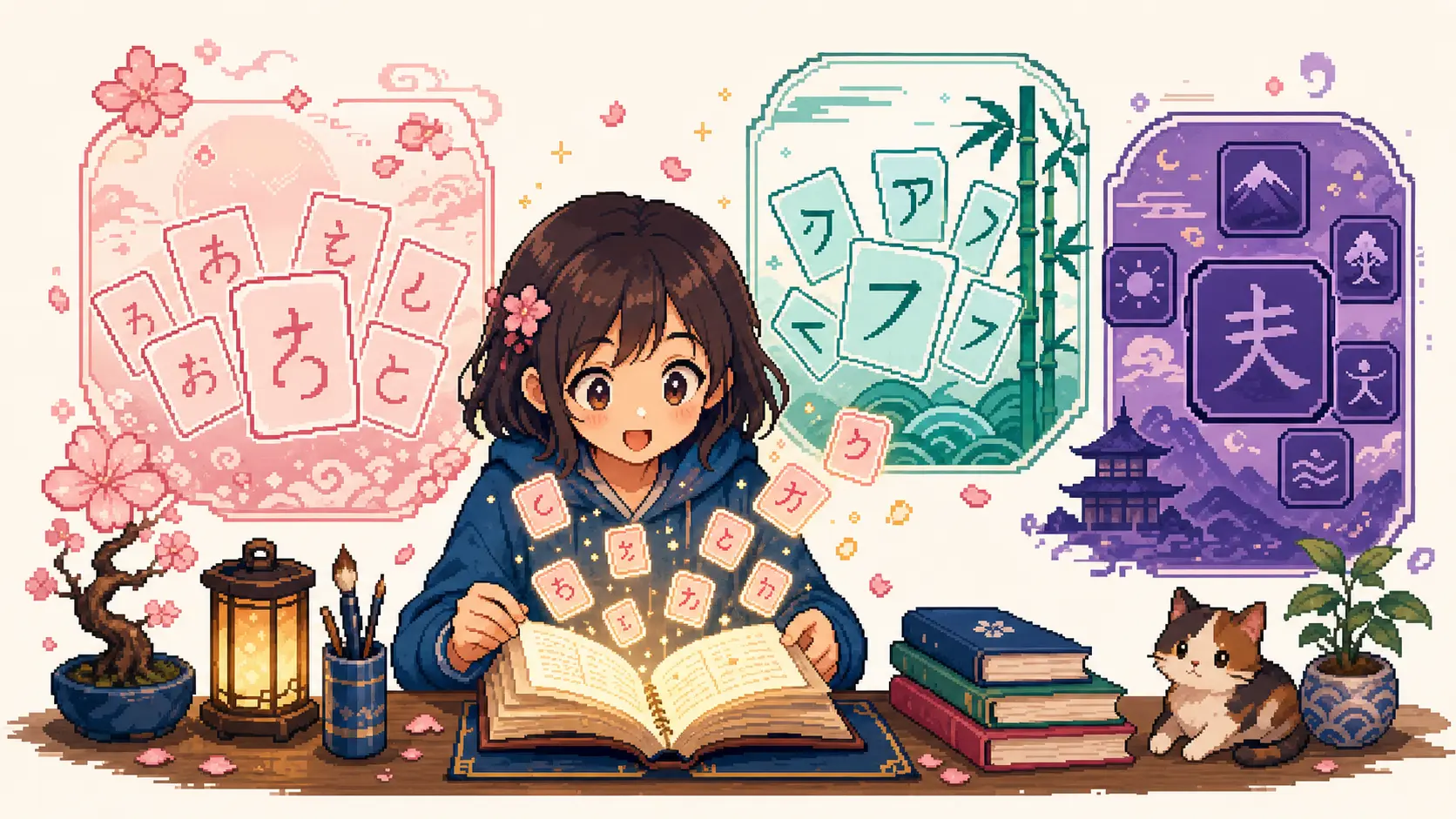
1. The Three Writing Systems
Before diving into Hiragana, it is important to understand how Japanese is written. A single sentence often uses all three systems together:
- Hiragana (ひらがな): Used for native Japanese words and grammar particles. It is curvy and soft.
- Katakana (カタカナ): Used for foreign loanwords and names. It is angular and sharp.
- Kanji (漢字): Symbols borrowed from Chinese that represent concepts/meanings.
あき は きれいです。
Aki wa kirei desu.
Autumn is beautiful.
Written entirely in Hiragana.
コーヒー を のみます。
Koohii o nomimasu.
I drink coffee.
Combines Katakana (コーヒー) and Hiragana (を、のみます).
日本 に いきます。
Nihon ni ikimasu.
I am going to Japan.
Combines Kanji (日本) and Hiragana (に、いきます).
2. The 46 Base Characters
Japanese is composed of 5 pure vowels and 41 consonant-vowel combinations. The chart below is the standard “A-I-U-E-O” order used in dictionaries.
Base sounds (gojūon)
Voiced & semi-voiced (dakuten ゛/ handakuten ゜)
Combined sounds (yōon)
あおい うみ
Aoi umi
Blue sea
Uses characters from the Vowel and M rows.
すし を たべます。
Sushi o tabemasu.
I eat sushi.
Note: を is pronounced 'o' when used as a particle.
さくら は きれいです。
Sakura wa kirei desu.
Cherry blossoms are beautiful.
Note: は is pronounced 'wa' when used as a particle.
Three kana with special particle readings
A few kana are read differently when they act as grammar particles (you’ll meet these in later chapters):
- は → read “wa” as the topic particle (otherwise “ha”).
- へ → read “e” as the direction particle (otherwise “he”).
- を → read “o”; in modern Japanese it appears only as the object particle.
Everywhere else, read them normally.
3. Voiced Marks (Dakuten & Handakuten)
By adding two small dots called Dakuten (゛) or a small circle Handakuten (゜) to specific rows, you create new sounds.
means Voicing shifts the sound of the consonant.
Formation
Character + ゛(Dakuten) OR ゜(Handakuten)
か (ka) + ゛ = が (ga)
ka -> ga
Unvoiced 'k' becomes voiced 'g'
さ (sa) + ゛ = ざ (za)
sa -> za
Unvoiced 's' becomes voiced 'z'
は (ha) + ゜ = ぱ (pa)
ha -> pa
Unvoiced 'h' becomes a popped 'p'
4. Combinations (Youon)
When a character from the “i” column (ki, shi, chi, ni, hi, mi, ri) is followed by a small ya (ゃ), yu (ゅ), or yo (ょ), the sounds blend together into a single syllable.
おちゃ を のみます。
Ocha o nomimasu.
I drink green tea.
ち (chi) + ゃ (small ya) = ちゃ (cha).
きゅうしゅう は にほん の しま です。
Kyuushuu wa Nihon no shima desu.
Kyushu is a Japanese island.
き (ki) + ゅ (small yu) = きゅ (kyu).
きょう は あついです。
Kyou wa atsui desu.
Today is hot.
き (ki) + ょ (small yo) = きょ (kyo).
5. Long Vowels (長音, Chouon)
A long vowel is held for two beats (mora) instead of one — and the length can change the meaning of a word. In hiragana you extend a vowel by adding a second vowel kana. Four rows simply repeat the vowel; the お and え rows follow a special rule.
means Hold the vowel for two beats. The え-row usually adds い, and the お-row usually adds う.
Formation
[kana] + matching vowel (お-row + う, え-row + い)
おかあさん
okaasan
mother (a + あ)
おにいさん
oniisan
older brother (i + い)
くうき
kuuki
air (u + う)
せんせい
sensei
teacher (え-row + い → long 'e')
がっこう
gakkou
school (お-row + う → long 'o')
Spelling vs. sound: おう and えい
Even though おう is written with う, it is pronounced as a long “o” (like oo), and えい is pronounced as a long “e” (like ee). That is why this book romanizes them as ou and ei — matching the kana you actually write.
A handful of words break the pattern and double the vowel directly (おお / ええ) — just memorize these:
- おおきい (ookii) — big
- とおい (tooi) — far
- こおり (koori) — ice
- おねえさん (oneesan) — older sister
6. Double Consonants (The Small っ, Sokuon)
A small っ — written smaller and lower than a full つ — is called the sokuon. It is never read on its own; instead it creates a short, sharp pause that doubles the consonant of the kana that follows.
きって
kitte
postage stamp
The small っ doubles the 't': ki–(pause)–te.
ざっし
zasshi
magazine
っ + し doubles the 's' sound.
がっこう
gakkou
school
Combines a double consonant (っこ) and a long vowel (おう).
Small っ vs. full つ
Size matters! The small っ marks a pause, while the full-size つ is the syllable tsu. Mixing them up changes the word:
- きって (kitte) = stamp — but きて (kite) = “come.”
- Hold the pause for a full beat; rushing it makes you say a different word.
7. Writing Kana: Stroke Order
You can read kana in any order, but writing them in the correct stroke order keeps your characters balanced and legible — and it builds the muscle memory you’ll rely on later for kanji. Three universal rules cover almost every kana:
- Top → bottom — write upper strokes before lower ones.
- Left → right — write left strokes before right ones.
- Horizontal before vertical — when strokes cross, the horizontal one usually comes first.
Enclosing or outer strokes generally come before what they contain, and most kana are written in just 1–4 strokes.
Direction is part of the character
Drawing a stroke in the wrong direction (e.g. bottom-to-top) changes its shape and makes look-alike kana harder to tell apart. The classic pair シ (shi) and ツ (tsu) in katakana differ mainly in stroke direction — so building the right habit now pays off in Chapter 2.
The Origins of Hiragana
Hiragana was developed in the 9th century by simplifying the cursive forms of Chinese characters. For a long time, it was known as onnade (女手), or “woman’s hand,” because it was primarily used by women in the imperial court to write poetry and literature, while men used Kanji for official documents. The Tale of Genji — often called the world’s first novel — was written largely in Hiragana. Today it is used by everyone and is valued for its fluid, aesthetic beauty.
Practical Conversations
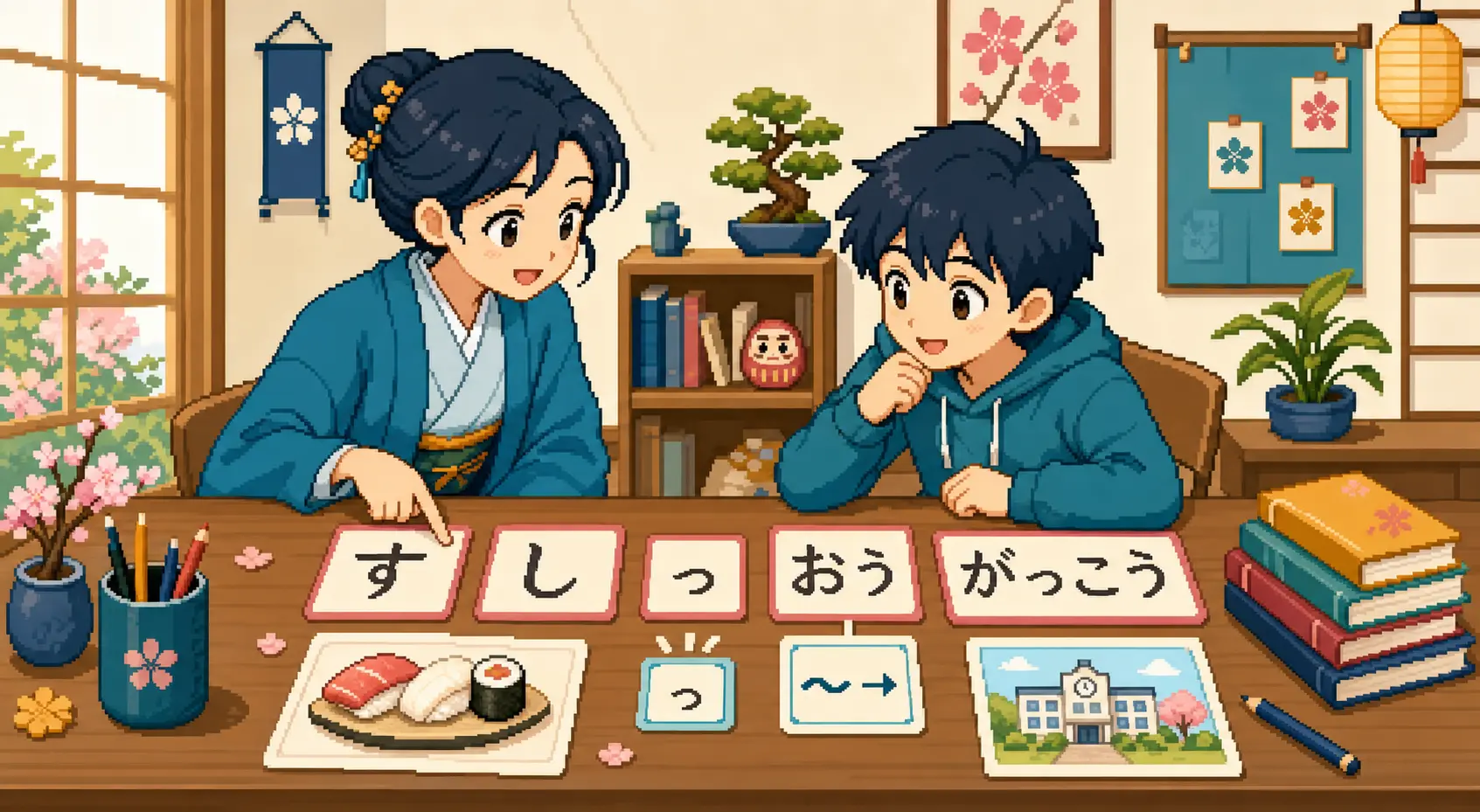
これ は なん です か。
Kore wa nan desu ka.
What is this?
これ は 「すし」 です。
Kore wa 'sushi' desu.
This is 'sushi'.
「す」 と 「し」 です ね。
'Su' to 'shi' desu ne.
It's 'su' and 'shi', right?
はい、そうです。
Hai, sou desu.
Yes, that's right.
これ は 「がっこう」 です か。
Kore wa 'gakkou' desu ka.
Is this 'gakkou' (school)?
はい。「がっこう」 です。
Hai. 'Gakkou' desu.
Yes. It is 'gakkou'.
ちいさい っ と おう が あります ね。
Chiisai tsu to ou ga arimasu ne.
It has a small っ and おう, right?
はい。おう は ながい お です。
Hai. Ou wa nagai o desu.
Yes. おう is a long o.
Chapter Summary
- 1Hiragana is the foundational writing system representing all 46 basic sounds.
- 2Japanese uses three systems: Hiragana (native), Katakana (foreign), and Kanji (meaning).
- 3Dakuten (゛) and Handakuten (゜) modify consonants to create sounds like G, Z, D, B, and P.
- 4Combined sounds (Youon) are formed by adding a small ya, yu, or yo to 'i' column characters.
- 5Long vowels (おう→long 'o', えい→long 'e') are held for two beats and can change a word's meaning.
- 6The small っ (sokuon) marks a pause that doubles the next consonant, as in きって (kitte).
- 7Proper stroke order — top→bottom, left→right, horizontal→vertical — keeps writing legible.
Knowledge Check
Test your mastery of Hiragana!
Which writing system is used for native Japanese words and grammar?
Practice Quiz
Which writing system is used for native Japanese words and grammar?
- Kanji
- Katakana
- Hiragana
- Romaji
Which of these is the correct Hiragana for 'A'?
- い
- う
- あ
- お
How do you produce the 'GA' sound in Hiragana?
- か + ゜
- か + ゛
- さ + ゛
- た + ゛
Which character is 'SHI'?
- ち
- し
- つ
- さ
How is 'PA' written?
- ば
- ぱ
- は
- ま
What sound does 'き' + 'ょ' (small) produce?
- kiyo
- kyo
- kiya
- kya
Which consonant can be written without a vowel?
- s (す)
- k (く)
- n (ん)
- m (む)
Correctly spell 'NEKO' (cat).
- ぬこ
- ねこ
- わこ
- めこ
What is the correct reading for 'おはよう'?
- o-ha-yo-u
- o-ha-yu-u
- a-ha-yo-u
- o-ho-yo-u
Identify 'ME'.
- ぬ
- ね
- め
- あ
Read the word: 'おちゃ'
- o-ki-ya
- o-chi-ya
- o-cha
- o-sa
Which row comes after the S-row (sa, shi, su, se, so)?
- K-row
- T-row
- N-row
- H-row
What is 'tsu' in Hiragana?
- す
- つ
- ち
- ぬ
Read the word: 'かぜ'
- kaze
- kase
- base
- gabe
How is the long vowel in 'がっこう' (school) written?
- お-row + お
- お-row + う
- お-row + ー
- お-row + あ
What does the small っ in 'きって' (stamp) do?
- Adds a 'tsu' sound
- Doubles the next consonant
- Makes a long vowel
- Marks a question
What does 'onnade' mean in the context of Hiragana's history?
- Beautiful handwriting
- Woman's hand
- Court poetry
- Simplified script
Applied review
Use what you learned
Focus: Hiragana recognition. Try the task before revealing the model.
Produce the Japanese sentence, then compare it with the model answer.
1.Write “I am Sakura” using hiragana for the name.
Hiragana recognition in context
N5 mini-reading
- What does Sakura practise every day?