Katakana & Basic Greetings
Learning objectives
- Read and write the 46 base Katakana characters.
- Understand long vowel marks (ー) and voiced sounds in Katakana.
- Spell modern loanwords using the small ッ and extended katakana (ファ, ティ, ウィ).
- Learn standard daily greetings and polite phrases.
- Identify common loanwords (Gairaigo) used in Japanese daily life.
Now that you’ve mastered Hiragana, it’s time to meet its angular sibling: Katakana. Katakana represents the same sounds but is used for foreign words, names, and emphasis. Along with this new script, we will learn the most essential Japanese greetings (Aisatsu), which are the building blocks of polite Japanese society.
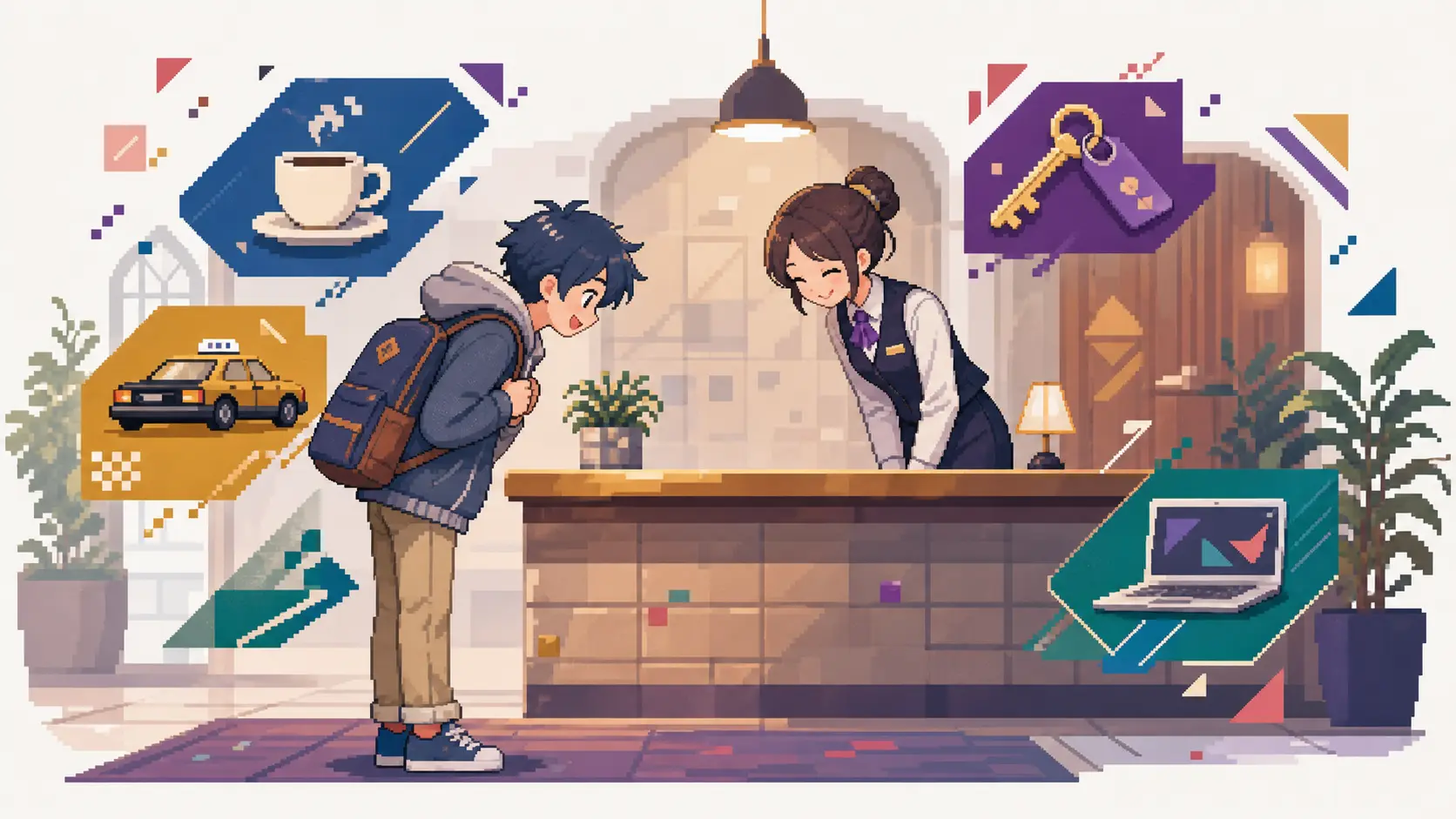
1. The 46 Katakana Characters
Katakana characters are sharper and more geometric than Hiragana. They are often simplified versions of Kanji.
Base sounds (gojūon)
Voiced & semi-voiced (dakuten ゛/ handakuten ゜)
Combined sounds (yōon)
Four look-alikes: シ・ツ and ソ・ン
Be careful with シ (shi) / ツ (tsu) and ソ (so) / ン (n) — each pair looks almost identical. The difference is in the stroke direction and angle:
- シ and ン end with a stroke swept upward from the bottom.
- ツ and ソ end with a stroke drawn downward from the top.
This is exactly why the stroke-order habits from Chapter 1 matter.
2. Voiced Marks & Long Vowels
Katakana uses the same Dakuten (゛) and Handakuten (゜) as Hiragana. Additionally, it uses a horizontal line (ー) called a chouonpu to indicate long vowel sounds.
means Modifying sounds and extending vowels in Katakana.
Formation
Character + Marks OR Character + ー
アメリカ (Amerika)
Amerika
America
コーヒー (Koohii)
Koohii
Coffee (Note the long vowels)
ベッド (Beddo)
Beddo
Bed (Note the small 'tsu' ッ for double consonant)
パソコン を かいました。
Pasokon o kaimashita.
I bought a personal computer.
Pasokon (パソコン) is short for 'Personal Computer'.
ホテル は どこ です か。
Hoteru wa doko desu ka.
Where is the hotel?
タクシー で いきます。
Takushii de ikimasu.
I will go by taxi.
3. Double Consonants (The Small ッ, Sokuon)
Just like hiragana’s small っ, katakana uses a small ッ to double the consonant of the kana that follows. It appears constantly in loanwords adapted from English.
ベッド
beddo
bed
The small ッ doubles the 'd': be–(pause)–do.
カップ
kappu
cup
ッ + プ doubles the 'p'.
サッカー
sakkaa
soccer
Combines a double consonant (ッカ) and a long vowel (カー).
4. Extended Katakana (Modern Loanword Sounds)
Because katakana exists to spell foreign words, Japanese added new combinations to capture sounds the base 46 cannot — like fa, ti, wi, and je. These are formed by writing a small vowel kana after a base kana (for example フ + small ェ = フェ, fe).
Extended sounds (for foreign loanwords)
ファイル
fairu
file
ファ (fa) — impossible to spell with the base kana alone.
パーティー
paatii
party
ティ (ti), plus the long vowels パー and ティー.
ウェブサイト
webusaito
website
ウェ (we) captures the English 'we' sound.
5. Essential Greetings (Aisatsu)
Greetings are the heart of Japanese communication. They are often set phrases that should be memorized as a whole.
おはようございます
Greetingohayou gozaimasu
Good morning (Polite)
こんにちは
Greetingkonnichiwa
Good afternoon / Hello
こんばんは
Greetingkonbanwa
Good evening
ありがとうございます
Phrasearigatou gozaimasu
Thank you very much
すみません
Phrasesumimasen
Excuse me / I'm sorry
はじめまして。 アンナ です。
Hajimemashite. Anna desu.
Nice to meet you. I am Anna.
よろしく おねがいします。
Yoroshiku onegaishimasu.
Please treat me well / I look forward to working with you.
さようなら。
Sayounara.
Goodbye.
6. Cultural Note: The Art of Bowing (Ojigi)
In Japan, greetings are almost always accompanied by a bow (ojigi). The depth and duration of the bow depend on the social situation:
- Eshaku (15°): A casual greeting to friends or acquaintances.
- Keirei (30°): The standard business bow, used for customers or superiors.
- Saikeirei (45°): A deep bow used for formal apologies or showing profound respect. Remember: keep your back straight and your eyes downcast!
Practical Conversations
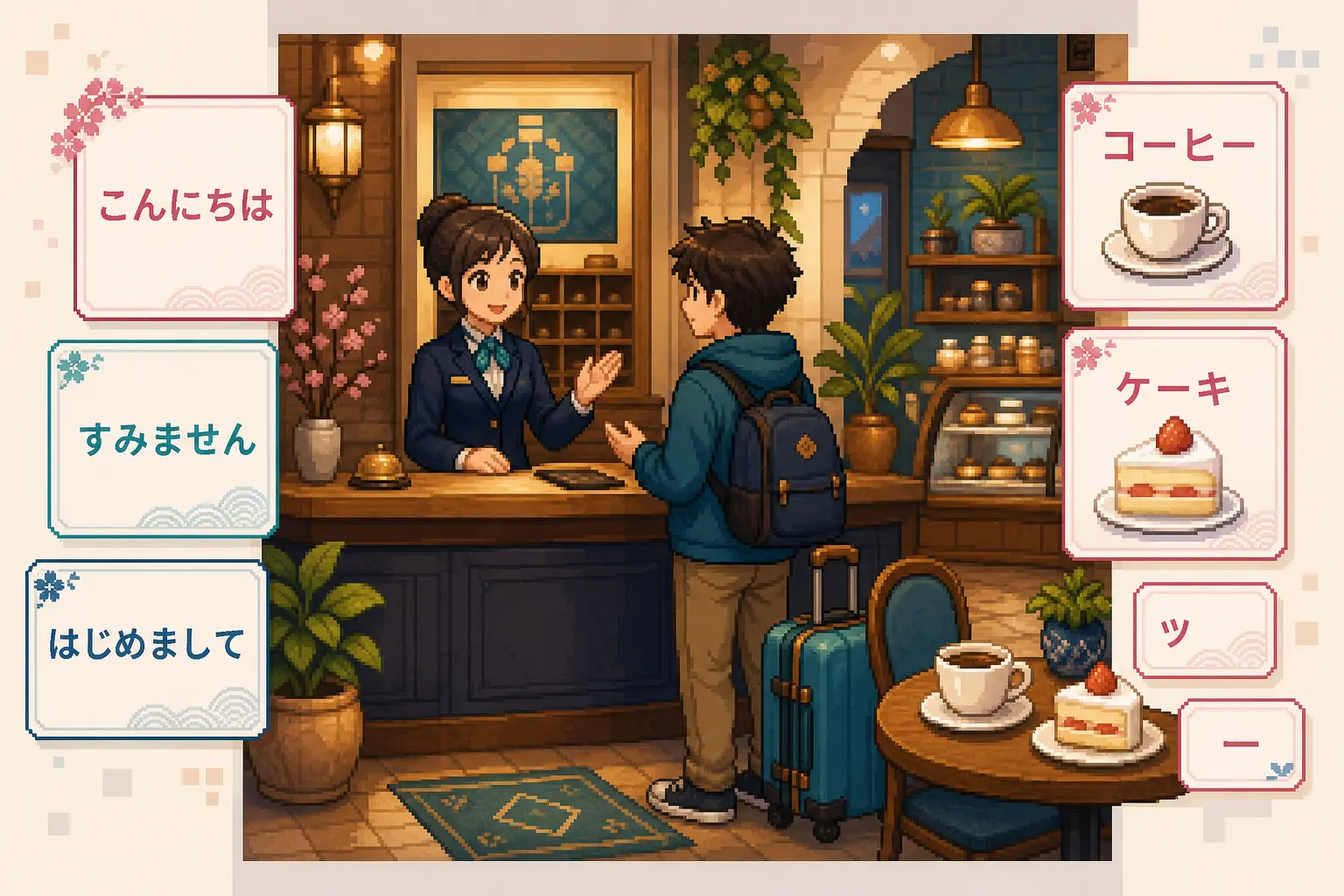
こんにちは。 すみません。
Konnichiwa. Sumimasen.
Hello. Excuse me.
こんにちは! いらっしゃいませ。
Konnichiwa! Irasshaimase.
Hello! Welcome.
わたし は スミス です。 はじめまして。
Watashi wa Sumisu desu. Hajimemashite.
I am Smith. Nice to meet you.
スミスさん です ね。 よろしく おねがいします。
Sumisu-san desu ne. Yoroshiku onegaishimasu.
Mr. Smith, right? Please treat me well.
すみません! コーヒー を ください。
Sumimasen! Koohii o kudasai.
Excuse me! Coffee, please.
はい、どうぞ。 ケーキ も いかが です か。
Hai, douzo. Keeki mo ikaga desu ka.
Yes, here you go. Would you like some cake too?
はい、ありがとうございます。 いただきます!
Hai, arigatou gozaimasu. Itadakimasu!
Yes, thank you very much. Let's eat!
Chapter Summary
- 1Katakana is used for foreign names, loanwords, and emphasis.
- 2Long vowels in Katakana are indicated by the straight line mark (ー).
- 3The small ッ doubles the next consonant (ベッド beddo), just like hiragana's っ.
- 4Extended katakana (ファ, ティ, ウィ, ジェ) spells sounds the base 46 can't, for modern loanwords.
- 5Japanese greetings (Aisatsu) change based on the time of day and politeness level.
- 6Bowing (Ojigi) is an essential non-verbal component of Japanese greetings.
- 7Many modern Japanese words like 'Pasokon' or 'Sumaho' are shortened loanwords.
Knowledge Check
Test your knowledge of Katakana and Greetings!
Which script is used for the word 'Coffee' (コーヒー)?
Practice Quiz
Which script is used for the word 'Coffee' (コーヒー)?
- Hiragana
- Kanji
- Katakana
- Romaji
What does the mark 'ー' represent in Katakana?
- A pause
- A long vowel
- A double consonant
- The end of a sentence
Which greeting is appropriate for 8:00 PM?
- こんにちは
- おはようございます
- こんばんは
- さようなら
What should you say before you start eating?
- ごちそうさまです
- いただきます
- はじめまして
- すみません
Which Katakana character is 'A'?
- イ
- ウ
- ア
- エ
How do you say 'Excuse me' or 'I'm sorry'?
- ありがとう
- すみません
- さようなら
- はい
What is 'Eshaku' in Japanese culture?
- A type of tea
- A 15-degree casual bow
- A 45-degree formal bow
- A morning greeting
Translate: 'はじめまして'
- Thank you
- Goodbye
- Nice to meet you
- I am a student
Which character is 'SHI' (シ)?
- ツ
- ソ
- ン
- シ
What does 'Gairaigo' refer to?
- Traditional Japanese clothes
- Loanwords from foreign languages
- Formal greetings
- Kanji characters
Read the word: 'ホテル'
- Hoteru
- Hatoru
- Futeru
- Hotalu
Which phrase ends a self-introduction politely?
- はじめまして
- よろしく おねがいします
- ありがとうございます
- さようなら
What is 'Konnichiwa' written with at the end?
- わ
- は
- あ
- お
How do you write 'Taxi' in Katakana?
- タカシー
- タクシー
- テクシー
- トクシー
What is the role of the small ッ in 'ベッド' (bed)?
- It is a 'tsu' sound
- It doubles the next consonant
- It lengthens the vowel
- It is silent decoration
Which extended katakana spells the 'fa' sound in 'ファイル' (file)?
- ハ
- ファ
- バ
- パ
Which bow is used for a formal apology?
- Eshaku
- Keirei
- Saikeirei
- Aisatsu
Applied review
Use what you learned
Focus: Katakana and greetings. Try the task before revealing the model.
Produce the Japanese sentence, then compare it with the model answer.
1.Write “coffee” and greet someone in the morning.
Katakana and greetings in context
N5 mini-reading
- Where does Maria work?