Numbers & Particles は and の
Learning objectives
- Read and write Kanji for numbers 1-10 and large units (100, 1000, 10000).
- Use the particle は (wa) to define the topic of a sentence.
- Use the particle の (no) to show possession and link nouns.
- Understand the cultural significance of numbers in Japan.
Now that you can read the phonetic scripts, it’s time to introduce Kanji—characters that represent meanings. We’ll start with the most basic building blocks: numbers. Additionally, we will learn how to connect these words into simple sentences using Particles, the “grammatical glue” of the Japanese language.
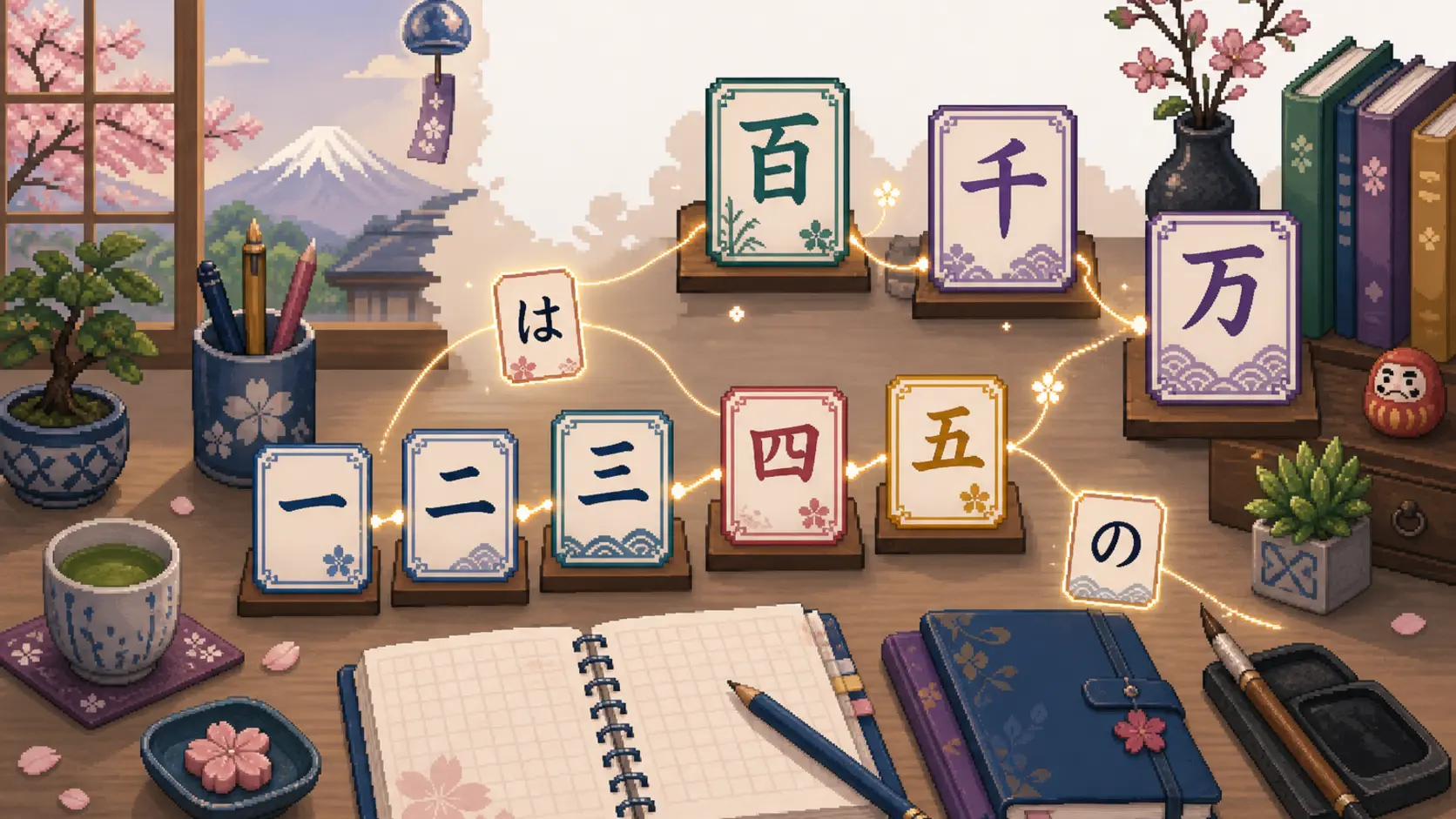
1. Kanji for Numbers (一 〜 十)
Japanese numbers from 1 to 10 are simple pictographs or symbols.
On'yomi
イチ (ichi)
Kun'yomi
ひと (hito)
Examples
- 一【いち】One
- 一つ【ひとつ】One thing
- 一月【いちがつ】January
On'yomi
ニ (ni)
Kun'yomi
ふた (futa)
Examples
- 二【に】Two
- 二つ【ふたつ】Two things
- 二月【にがつ】February
On'yomi
サン (san)
Kun'yomi
みっ (mit)
Examples
- 三【さん】Three
- 三つ【みっつ】Three things
- 三月【さんがつ】March
On'yomi
シ (shi)
Kun'yomi
よん (yon)
Examples
- 四【よん】Four
- 四つ【よっつ】Four things
- 四月【しがつ】April
On'yomi
ゴ (go)
Kun'yomi
いつ (itsu)
Examples
- 五【ご】Five
- 五つ【いつつ】Five things
- 五月【ごがつ】May
On'yomi
ロク (roku)
Kun'yomi
むっ (mut)
Examples
- 六【ろく】Six
- 六つ【むっつ】Six things
- 六月【ろくがつ】June
On'yomi
シチ (shichi)
Kun'yomi
なな (nana)
Examples
- 七【なな】Seven
- 七つ【ななつ】Seven things
- 七月【しちがつ】July
On'yomi
ハチ (hachi)
Kun'yomi
やっ (yat)
Examples
- 八【はち】Eight
- 八つ【やっつ】Eight things
- 八月【はちがつ】August
On'yomi
キュウ (kyuu)
Kun'yomi
ここの (kokono)
Examples
- 九【きゅう】Nine
- 九つ【ここのつ】Nine things
- 九月【くがつ】September
On'yomi
ジュウ (juu)
Kun'yomi
とお (too)
Examples
- 十【じゅう】Ten
- 十一【じゅういち】Eleven
- 二十【にじゅう】Twenty
2. Large Numbers (百, 千, 万)
Japanese counts large numbers in units of 10,000 (万).
On'yomi
ヒャク (hyaku)
Kun'yomi
—
Examples
- 百【ひゃく】One hundred
- 三百【さんびゃく】Three hundred
- 六百【ろっぴゃく】Six hundred
On'yomi
セン (sen)
Kun'yomi
ち (chi)
Examples
- 千【せん】One thousand
- 三千【さんぜん】Three thousand
- 八千【はっせん】Eight thousand
On'yomi
マン (man)
Kun'yomi
—
Examples
- 一万【いちまん】Ten thousand
- 十万【じゅうまん】One hundred thousand
- 百万【ひゃくまん】One million
3. The Topic Marker: は (wa)
The particle は (wa) identifies what the sentence is about. Think of it as “As for [topic]…”.
[!CAUTION] As a particle, the character は (ha) is always pronounced “wa”.
means Identifies the topic of the sentence.
Formation
Noun + は + [Description/State]
わたし は 学生 です。
Watashi wa gakusei desu.
I am a student. (As for me, I am a student.)
これ は ペン です。
Kore wa pen desu.
This is a pen.
きょう は さんじゅうにち です。
Kyou wa sanjuu-nichi desu.
Today is the 30th.
4. The Possession Marker: の (no)
The particle の (no) connects two nouns, showing that the first noun possesses or modifies the second. It works like the English apostrophe-s (‘s).
means Shows possession or relationship (Noun 1's Noun 2).
Formation
Owner + の + Item
わたし の 本
Watashi no hon
My book
先生 の 車
Sensei no kuruma
The teacher's car
日本 の カメラ
Nihon no kamera
A Japanese camera (Camera of Japan)
5. Cultural Note: Lucky and Unlucky Numbers
In Japan, numbers carry deep cultural meanings.
- Four (四): Often avoided because one of its readings, shi, sounds exactly like the word for Death (死). You’ll often see buildings without a 4th floor!
- Nine (九): Sometimes considered unlucky because its reading ku sounds like Suffering (苦).
- Seven (七): Considered lucky, much like in the West, and associated with the “Seven Lucky Gods” of Japanese mythology.
- Eight (八): Very lucky because the Kanji widens at the bottom, suggesting growing prosperity.
Practical Conversations
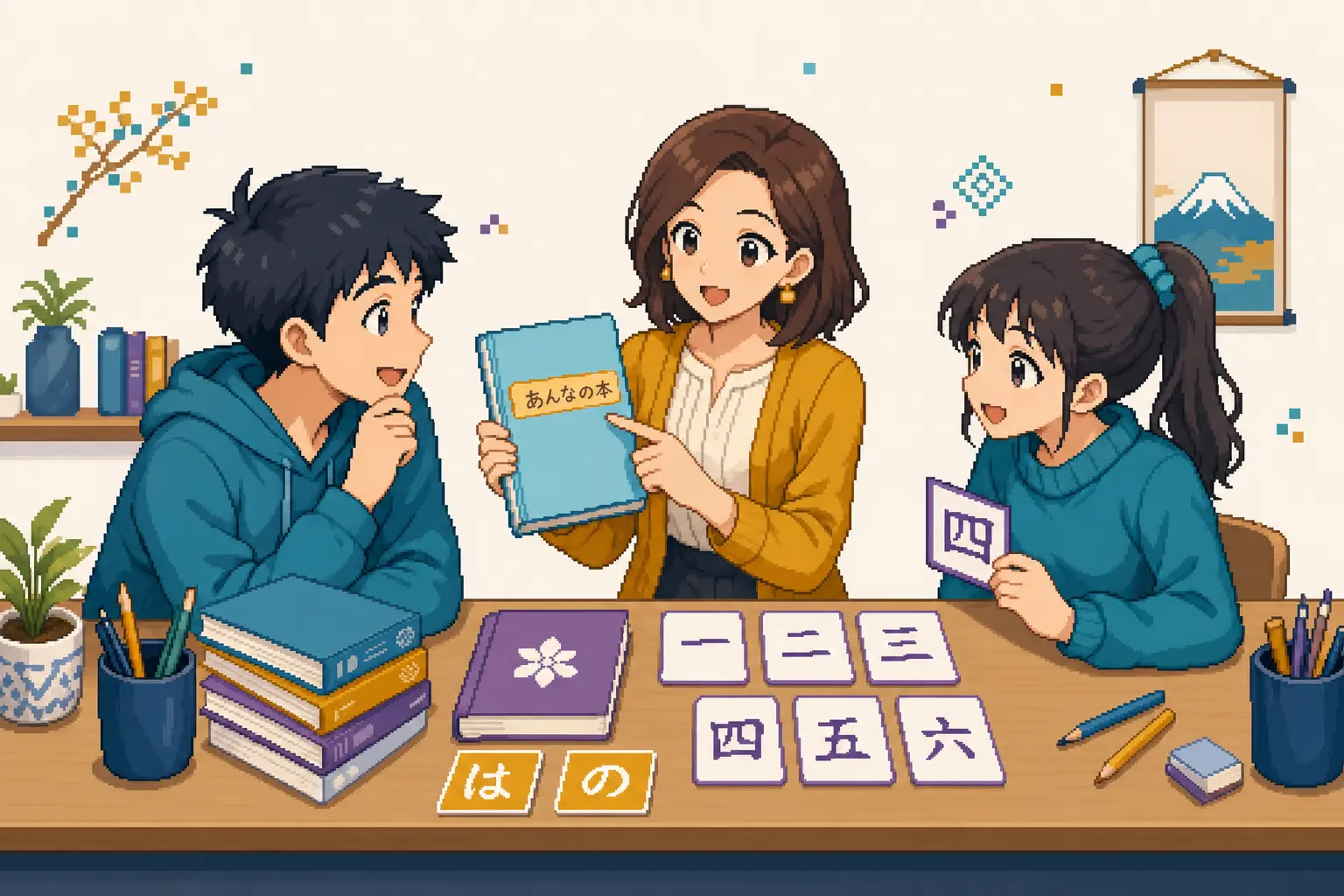
スミスさん、これ は あなた の 本 です か。
Sumisu-san, kore wa anata no hon desu ka.
Mr. Smith, is this your book?
いいえ、それ は わたし の 本 ではありません。
Iie, sore wa watashi no hon dewa arimasen.
No, that is not my book.
だれ の です か。
Dare no desu ka.
Whose is it?
それ は アンナさん の 本 です。
Sore wa Anna-san no hon desu.
That is Anna's book.
電話番号 は なん です か。
Denwa bangou wa nan desu ka.
What is your phone number?
ぜろ・きゅう・ぜろ の いち・に・さん・よん です。
Zero kyuu zero no ichi ni san yon desu.
It's 090-1234.
ありがとうございます。
Arigatou gozaimasu.
Thank you very much.
Chapter Summary
- 1Kanji like 一, 二, 三 represent numerical values and meanings.
- 2The particle は (wa) marks the topic of the sentence. It is written as 'ha'.
- 3The particle の (no) shows possession or links nouns (Owner の Item).
- 4Numbers 4 and 9 are often avoided in Japan due to unlucky homophones.
- 5Japanese counts in units of 10,000 (万) for large numbers.
Knowledge Check
Test your understanding of numbers and basic particles!
Which Kanji represents the number 'Three'?
Practice Quiz
Which Kanji represents the number 'Three'?
- 二
- 四
- 三
- 川
How is the topic particle は pronounced?
- ha
- wa
- ba
- pa
Which particle should you use to say 'My cat'?
- は
- の
- が
- を
What is the reading for '十一'?
- Juu
- Ichi-juu
- Juu-ichi
- Ni-juu
Why is the number 4 (四) often considered unlucky in Japan?
- It sounds like 'Suffering'
- It sounds like 'Death'
- It represents bad luck in war
- It is an even number
Translate: 'わたし の 先生'
- I am a teacher
- My teacher
- The teacher's book
- Teacher and I
What does the Kanji '十' represent?
- Five
- Seven
- Ten
- Thousand
In the sentence 'Tanaka-san wa gakusei desu', what is the topic?
- Gakusei
- Tanaka-san
- Desu
- Wa
How do you write '100' in Kanji?
- 千
- 万
- 百
- 十
Which of these means 'Japan's car'?
- 日本 は 車
- 日本 の 車
- 車 の 日本
- 日本 を 車
What is the reading for the Kanji '二'?
- Ichi
- San
- Ni
- Go
Which particle acts like the English 's?
- は
- の
- を
- が
Translate: 'これ は なん です か。'
- Who is this?
- What is this?
- Where is this?
- Whose is this?
What is the Kanji for 'Thousand'?
- 百
- 千
- 万
- 十
Which number is associated with 'Seven Lucky Gods'?
- 四
- 八
- 七
- 九
Applied review
Use what you learned
Focus: Numbers, は, and の. Try the task before revealing the model.
Produce the Japanese sentence, then compare it with the model answer.
1.Say “This is my three-hundred-yen notebook.”
Numbers, は, and の in context
N5 mini-reading
- Which item costs three hundred yen?