Beginning Japanese
日本語を始める
A comprehensive starter guide mapping out the Japanese writing systems, sentence ordering rules, core particles, and basic verb structures.
Table of Contents
1. The Writing System
Understanding Hiragana, Katakana, and Kanji characters.
2. Sentence Structure: SOV
Why the verb always anchors the end of Japanese clauses.
3. Particles: Grammar Glue
How wa, ga, wo, ni, de attach suffixes to define roles.
4. Basic Grammar Concepts
Plurals, lack of future tense, and politeness parameters.
5. Verb Basics
Polite present, past, and negative verb conjugations.
6. Putting It Together
Interactive breakdowns of complex combined clauses.
1. The Writing System
Japanese does not use a single alphabet. It leverages three distinct scripts that cooperate dynamically to form sentences.
Study Book deep-dives: Ch.1 · Hiragana · Ch.2 · Katakana.

Arigatou — Thank you
Kamera — Camera
Nihon — Japan
Sentence Composition
A standard sentence blends all three styles seamlessly:
私はパスタを食べました。
(Watashi wa pasuta o tabemashita.)
Kanji (Roots)
私 (I) · 食 (Eat)
Hiragana (Grammar)
は (Topic) · べました (Past verb)
Katakana (Loanwords)
パスタ (Pasta)
2. Sentence Structure: SOV
English operates on an SVO (Subject-Verb-Object)structure. Japanese operates on an SOV (Subject-Object-Verb)structure.
I (S)drink (V)water (O).
I (S)water (O)drink (V).
The Golden Rule
The verb always anchors the endof a Japanese clause. As long as correct particles tag the words, you can shift the subject and object ordering without losing sentence coherence.
Watashi wa sushi o tabemasu.
(I / as for / sushi / [object] / eat)
→ "I eat sushi."
3. Particles: The Grammar Glue
Because word positioning is flexible, suffixes called particles (助詞 - joshi)tag nouns to indicate their grammatical role (e.g. topic, target, location, object).
Study Book deep-dive: Ch.16 · Particles Recap.
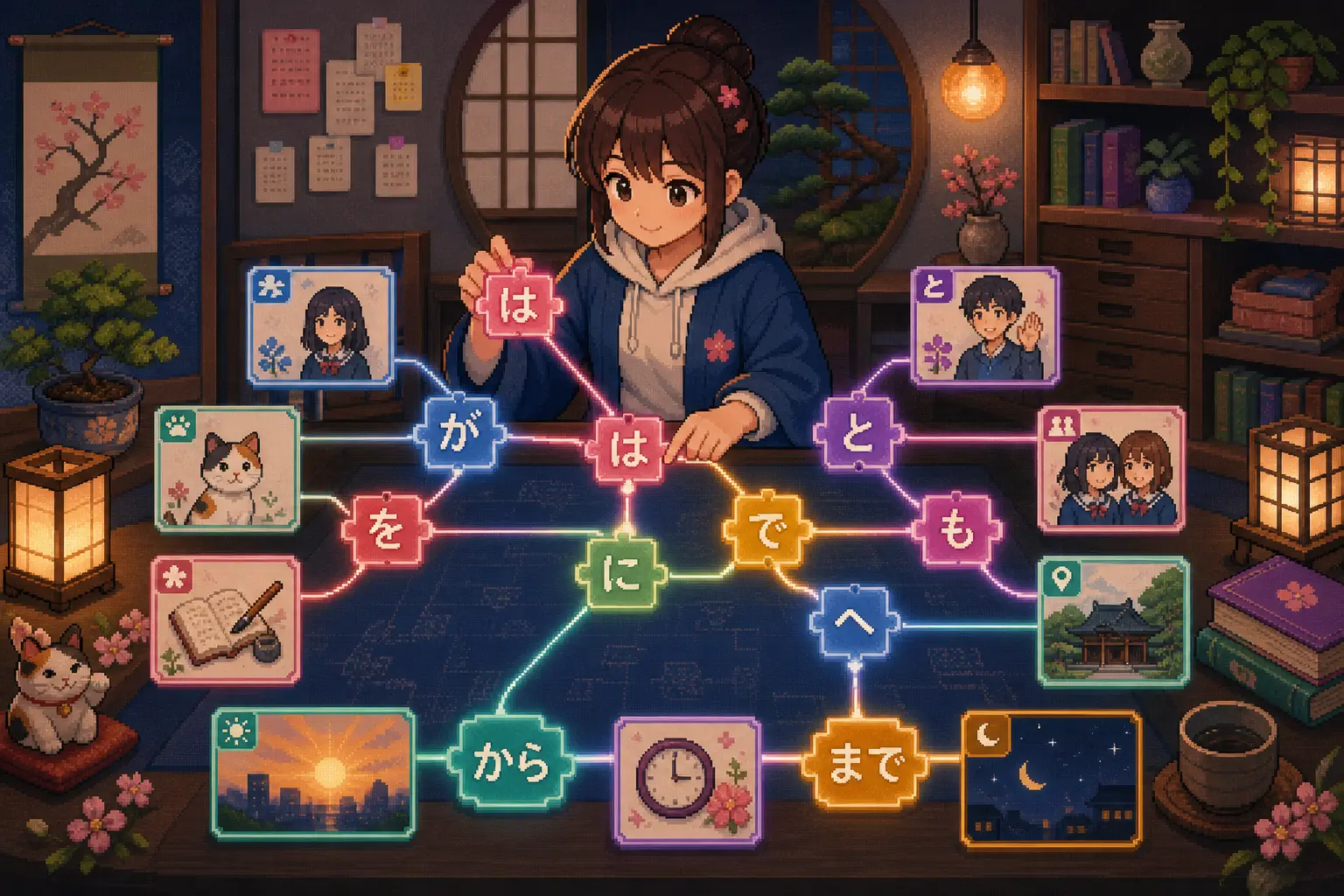
Functional Role Tagging
4. Basic Grammar Concepts
No Plurals
Japanese nouns lack separate plural conjugations. Context or indicators specify totals.
猫 (Neko) = Cat
猫 (Neko) = Cats
No Future Tense
Verbs conjugate only into Past and Non-Past forms. Future intents are established by time markers.
Past:Finished events
Non-Past:Ongoing / future
Politeness Levels
Speech structures shift based on seniority, familiarity, and respect.
Casual:Taberu (eat)
Polite:Tabemasu (eat)
5. Verb Basics
Verbs are conjugated to indicate politeness, time, and negativity. Here is the standard polite (ます - Masu) system.
Study Book deep-dive: Ch.10 · Verb Conjugation (ます-form).
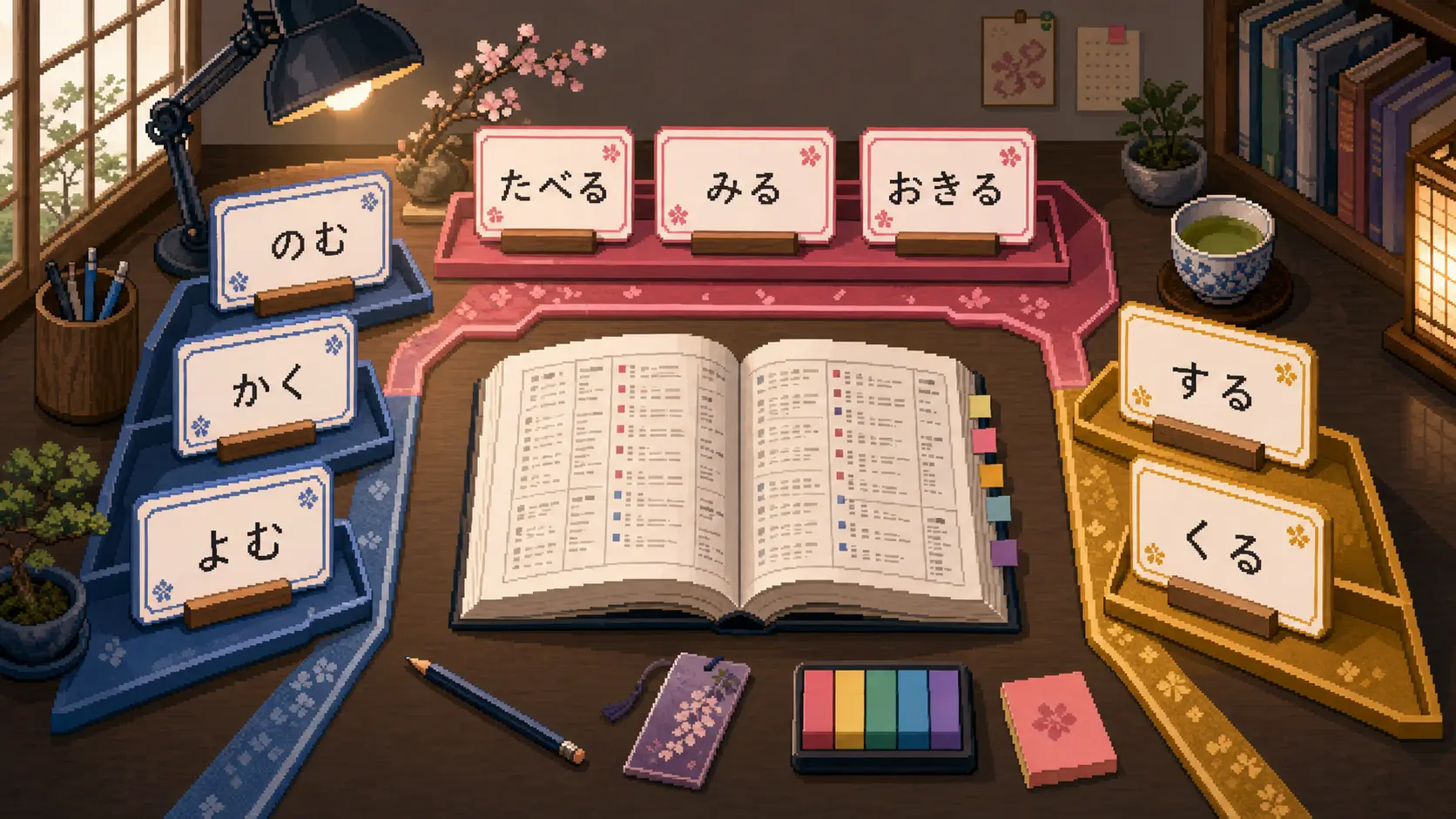
Masu-conjugation Applications
Ashita, ikimasu.
(Tomorrow, I will go.)
Kinou, tabemashita.
(Yesterday, I ate.)
Nomimasen.
(I do not drink.)
6. Putting It All Together
Let's analyze a complete sentence containing multiple concepts combined:
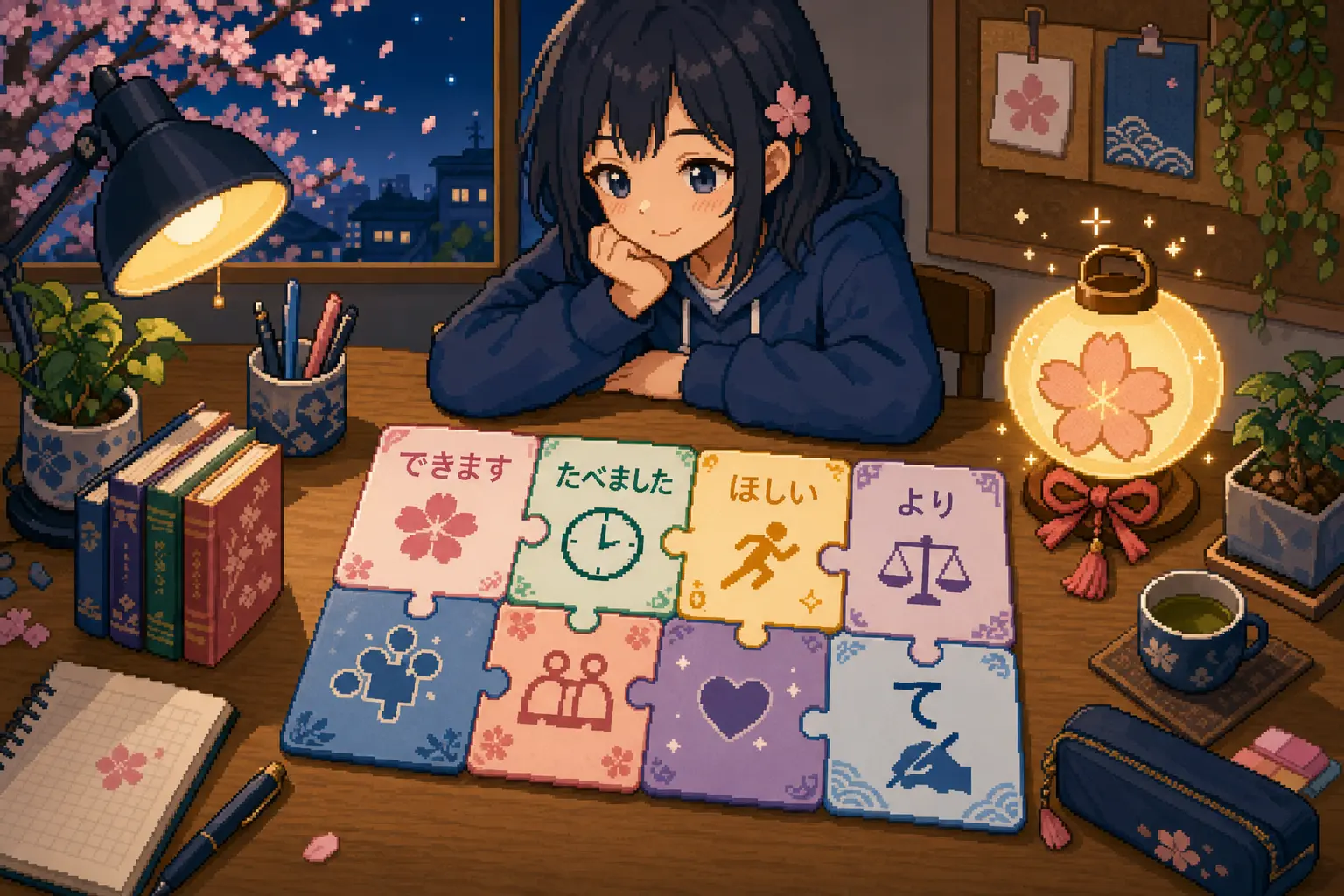
私は友達とレストランで昼ご飯を食べます。
Watashi wa tomodachi to resutoran de hirugohan o tabemasu.
Watashi (I) + は (wa)
Establishes the sentence topic: "As for me..."
Tomodachi (Friend) + と (to)
Defines association/accompaniment: "...together with a friend..."
Resutoran (Restaurant) + で (de)
Defines the location where the event occurs: "...at a restaurant..."
Hirugohan (Lunch) + を (o)
Identifies the target of the consumption: "...lunch..."
Tabemasu (Will eat)
The terminal verb indicating present/future action: "...will eat."
Final Thoughts
While Japanese appears complex initially, it is highly systemic and logical. Focus on small daily practice inputs (15-20 mins) rather than long, occasional cram sessions.
Ready to practice?
Begin with Japanese characters (Kana) or browse the detailed 40-chapter reference guide.