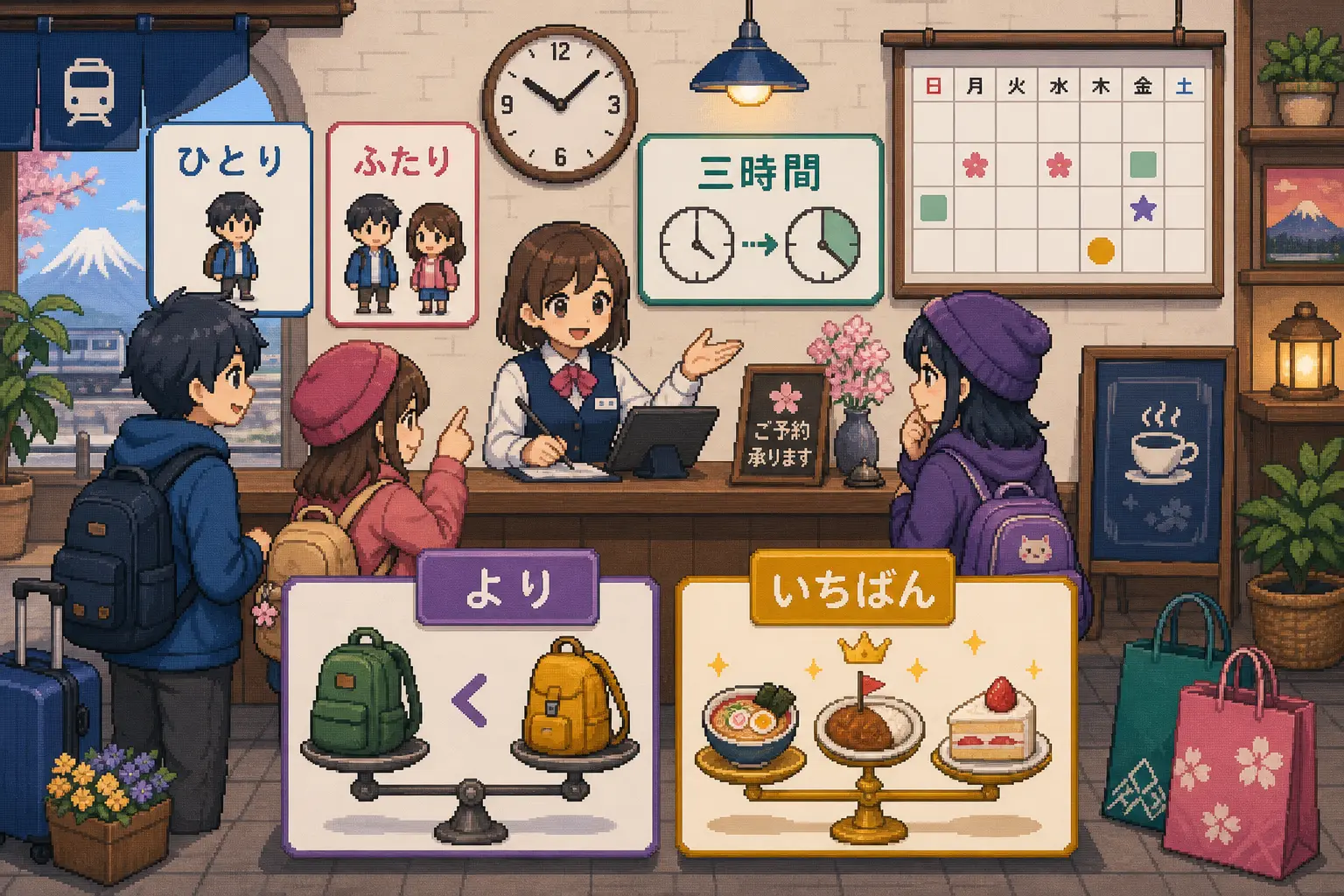
Japanese uses two parallel number systems and a set of counters that change depending on what you are counting. Learning the core numbers and the most common counters unlocks prices, quantities, schedules, and everyday requests.
Who this is for
Best for beginners, travelers, and anyone who needs to handle prices, quantities, and times in Japanese
Central idea
There are two ways to say most numbers in Japanese, and counting objects requires a word called a counter that changes by category. Most real-life situations use the same handful of counters.
Key highlights
Japanese has two number systems — Sino-Japanese and native Japanese — used in different situations.
Counters (助数詞) come after numbers and change depending on what you are counting.
Prices, phone numbers, and addresses use the Sino-Japanese system.
Time and dates follow predictable patterns once you know the root numbers.
Numbers come up constantly in Japan: prices at the register, floor levels in department stores, train arrival times, and the count of items you want to order. Getting comfortable with numbers early removes friction from dozens of daily interactions.
Counters
Numeric values attach specific counter suffixes depending on the shape and nature of items.
Core Concept
Two Systems, One Set of Situations
Japanese has Sino-Japanese numbers (based on Chinese) and native Japanese numbers. Prices, time, and most counting use Sino-Japanese. The native system is mostly used for counting small quantities of general objects (1–10).
The Sino-Japanese Number System
This is the system you will use for prices, phone numbers, floors, train times, and most counters. It follows a logical pattern that scales cleanly once you know the base units.
Vocabulary
一 / 二 / 三
ichi / ni / san
1 / 2 / 3
The building blocks of all larger numbers.
Vocabulary
四 / 五 / 六
shi (yon) / go / roku
4 / 5 / 6
4 has two readings: shi and yon. Yon is more common in everyday speech.
Vocabulary
七 / 八 / 九 / 十
nana (shichi) / hachi / kyuu (ku) / juu
7 / 8 / 9 / 10
7 has two readings (nana / shichi) and 9 has two (kyuu / ku). Context and the counter attached often determine which to use.
Pattern
Building Bigger Numbers
Numbers over ten follow a simple additive pattern. 十一 (juuichi) = 11, 二十 (nijuu) = 20, 三十五 (sanjuugo) = 35. After 99, you reach 百 (hyaku) for 100, 千 (sen) for 1,000, and 万 (man) for 10,000.
Vocabulary
十
juu
10
The base for teen numbers. 14 = juushi or juuyon.
Vocabulary
百
hyaku
100
三百 (sanbyaku) = 300. Note the pronunciation shift from hyaku to byaku after san.
Vocabulary
千 / 万
sen / man
1,000 / 10,000
Japanese groups large numbers by ten-thousands, not thousands. 50,000 = 五万 (goman).
At the Register
いくらですか。
Ikura desu ka.
How much does it cost?
The first question you will need when a price is not clearly displayed. Common in markets and smaller shops.
Quoting a Price
二千三百円です。
Nisen sanbyaku en desu.
It is 2,300 yen.
Prices in Japanese are read straight across: ni (2) + sen (1,000) + san (3) + hyaku (100).
The Native Japanese Number System
Native Japanese numbers only go up to ten in common use and are often called 訓読み (kun’yomi) numbers. They are used with the general counter 個 (ko) for small objects and in some casual fixed expressions.
Vocabulary
ひとつ / ふたつ / みっつ
hitotsu / futatsu / mittsu
1 / 2 / 3 things (general)
The native system with tsu appended. Used when counting general objects without specifying a counter.
Vocabulary
よっつ / いつつ / むっつ
yottsu / itsutsu / muttsu
4 / 5 / 6 things (general)
Beyond ten, the tsu form disappears and the Sino-Japanese system takes over for most scenarios.
Ordering Food
みっつください。
Mittsu kudasai.
Three, please. / I'll take three.
Using the native number + kudasai is a quick way to order items at food stalls or small shops without needing a specific counter.
Counters: Matching the Number to the Object
Japanese uses 助数詞 (josuushi), or counters, which are suffixes that change depending on what category of thing you are counting. You cannot just say “five” — you need “five flat things” or “five long things” depending on the object.
Practical List
The Most Important Counters
You do not need all counters at once. The five below cover the majority of everyday situations: ordering food, buying tickets, shopping, and scheduling.
Vocabulary
〜個
〜ko
General counter for small objects
Safe default for most solid, compact items: apples, boxes, cans. 一個 (ikko), 二個 (niko).
Learn the Sino-Japanese 1–10 first — they carry 90% of daily use.
Add 〜個 as your default counter when unsure. It is widely understood and rarely rude.
Practice reading prices out loud in shops, even silently, to build speed.
Note that yon (4) and nana (7) are safer defaults than shi and shichi in most casual speech.
Don’t
Do not use the native system (hitotsu, futatsu…) beyond small quantities — it sounds awkward past ten.
Do not mix the hour counter 時 (ji) with the general object counter 個 (ko) — they are completely different words.
Do not panic about counter exceptions early on. Saying the wrong counter is understood; say it confidently and correct it when you learn the right one.
Do not forget that 万 (10,000) is the unit Japanese uses for large numbers, not 千 (1,000) the way English does.
Precision Note
Number pronunciation shifts slightly in combination. Some counters trigger sound changes — for example 一本 is ippon, not ichi-hon. These patterns become natural with repetition. Focus on usage before worrying about every exception.
Source Links
These are the source pages used to ground this guide.